

Imagine this: It’s mid-2026, and your team’s AI agents have just drafted a full campaign strategy, analyzed competitor data in seconds, and even generated personalized content for thousands of customers. Sounds like the future we’ve been promised, right?
Yet here’s the surprising truth that McKinsey, Harvard Business School, and global leaders are highlighting right now: the companies (and professionals) pulling ahead aren’t the ones with the most powerful AI tools. They’re the ones whose human skills are sharper than ever.
Welcome to the real 2026 AI Revolution. Far from replacing us, advanced AI is making uniquely human abilities—judgment, empathy, creativity, and adaptability—more valuable than they’ve ever been. If you’re a business leader, marketer, or professional navigating this shift, this article is your practical guide.
The 2026 Reality: AI Amplifies Human Work, It Doesn’t Replace It
We’ve moved past the hype. Agentic AI and multi-agent systems are now everyday tools, handling routine tasks at lightning speed. But as McKinsey’s latest research shows, human skills will matter more than ever in the age of AI. Why? Because AI excels at information processing and pattern recognition—yet it still struggles with ambiguity, ethical nuance, emotional intelligence, and genuine innovation.
A Workday global survey confirms what 83% of employees already sense: AI is making uniquely human skills more critical, not less. In 2026, success belongs to those who master human-AI collaboration, turning powerful tools into true teammates rather than competitors.
The result? A new premium on “change fitness”—the ability to adapt quickly, orchestrate AI workflows, and bring irreplaceable human insight to every decision.
Why Human Skills Are Surging in Value Right Now
AI automates the “what” and “how” of many tasks, but it can’t replicate the “why” or the deeper context that drives real results. Here’s what leading 2026 reports reveal:
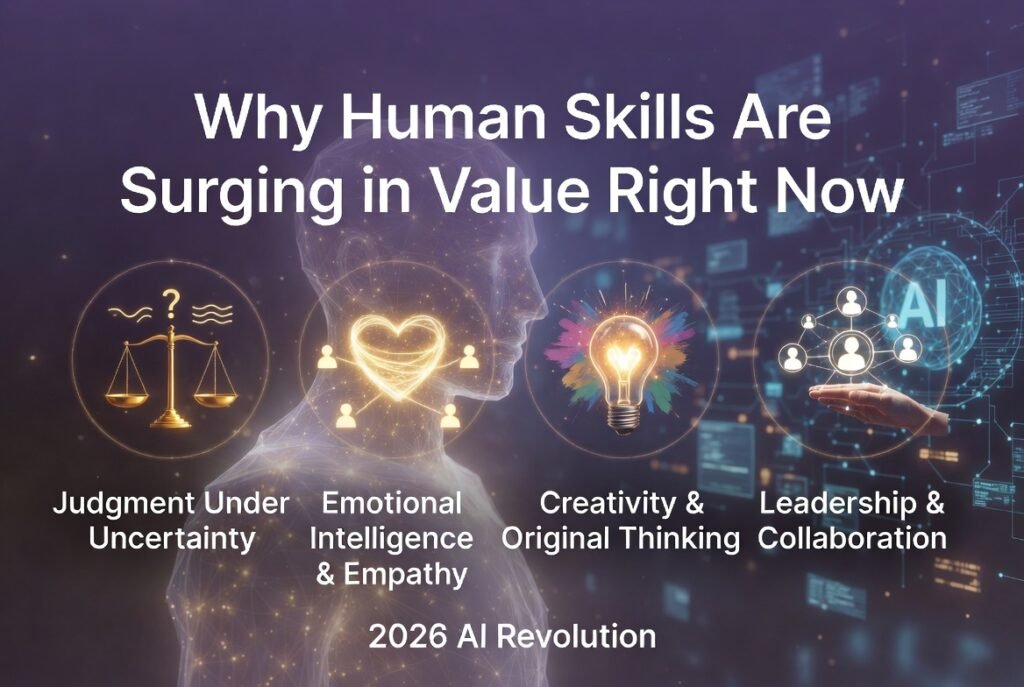
- Judgment under uncertainty: AI can crunch data, but only humans can weigh trade-offs, read the room, and make ethical calls when the stakes are high.
- Emotional intelligence and empathy: Building trust, motivating teams, and creating meaningful connections remain 100% human territory.
- Creativity and original thinking: AI remixes existing patterns. True innovation comes from human curiosity and the courage to explore the unknown.
- Leadership and collaboration: Orchestrating human-AI teams, fostering psychological safety, and turning insights into action are skills that define high-performing organizations.
World Economic Forum experts put it perfectly: in the AI era, agency—not just information—sets people apart. The abilities to ask better questions, navigate ambiguity, and turn ideas into impact are now your biggest competitive edge.
The 5 Human Skills AI Can’t Replicate (And How to Strengthen Them in 2026)
Let’s get practical. These are the capabilities that will separate top performers from the rest as the 2026 AI Revolution accelerates.
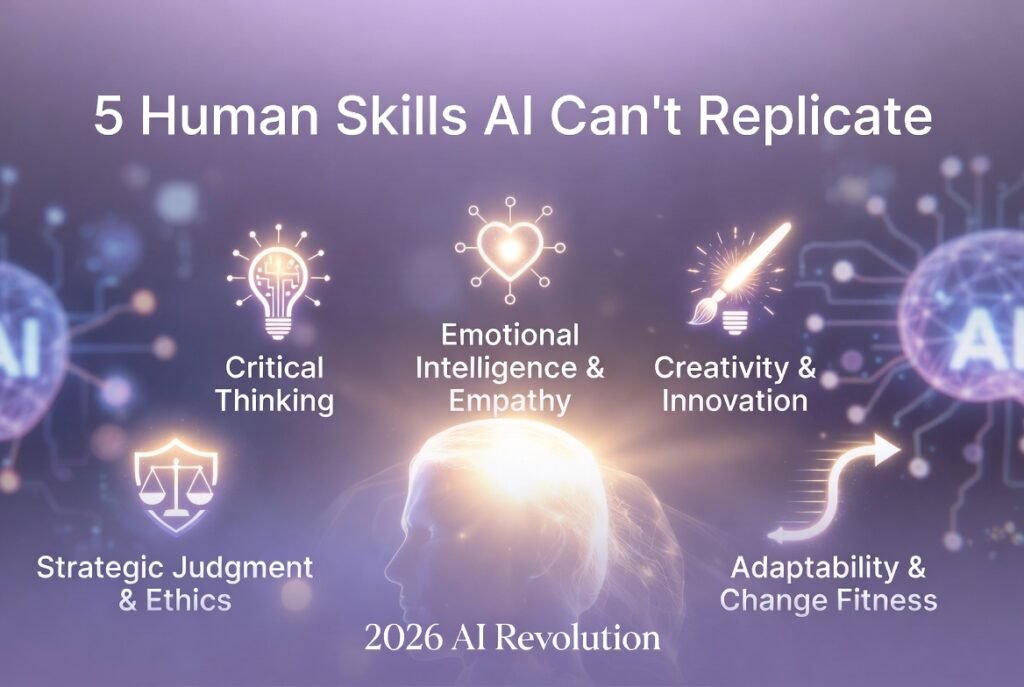
- Critical Thinking & Problem Framing AI is brilliant at solving problems you clearly define. But identifying the right problem in complex, ambiguous situations? That’s pure human strength. Actionable tip: Start every project with a 10-minute “first-principles” session. Ask: What are we really trying to achieve? Challenge AI outputs by asking, “What assumptions is this missing?”
- Emotional Intelligence & Empathy Whether you’re leading a remote team or crafting customer experiences, understanding emotions drives connection and loyalty. AI can simulate tone, but it can’t genuinely feel or build trust. Actionable tip: Practice “empathy mapping” before every major decision or campaign. How will this feel for your team or audience? Use AI for data, but lead with human insight.
- Creativity & Courageous Innovation LinkedIn’s CEO highlights curiosity, courage, and creativity as irreplaceable. AI generates options; humans decide which bold ideas are worth pursuing. Actionable tip: Schedule weekly “AI + human brainstorming” sessions. Let AI handle the first draft—then bring your unique perspective to refine, challenge, and elevate it.
- Adaptability & Change Fitness Harvard Business School calls this the ultimate 2026 differentiator. Change fitness is your ability to learn, unlearn, and relearn rapidly while staying grounded. Actionable tip: Build a personal “change fitness” routine: dedicate 30 minutes daily to experimenting with new AI tools, reflecting on what worked, and adjusting your workflow.
- Strategic Judgment & Ethical Leadership In an era of agentic AI, someone must own accountability, set guardrails, and ensure technology serves human goals. That someone is you. Actionable tip: Create simple “human override” checklists for every AI-assisted decision. Ask: Does this align with our values? Who benefits—and who might be left behind?
Human-AI Collaboration: Your Practical Playbook for 2026 Success
The winners aren’t fighting AI—they’re partnering with it. Here’s how professionals are thriving right now:
- Treat AI as your most capable junior teammate: Give it clear direction, review its work critically, and celebrate when human insight improves the outcome.
- Invest in broad AI literacy across your team (not just technical experts). Everyone needs enough fluency to ask smart questions and interpret results.
- Redesign workflows for hybrid intelligence: Let AI handle repetitive tasks so humans can focus on high-value judgment, relationships, and innovation.
- Measure what matters: Track not just productivity metrics, but also team wellbeing, creativity output, and client satisfaction—the human-led outcomes that drive long-term success.
For marketers and business leaders especially, this means using AI to scale content and analysis while doubling down on authentic storytelling, audience empathy, and strategic vision that no algorithm can replicate.
The Human Edge: Turning AI Anxiety into Your Greatest Advantage
Yes, the pace of change can feel intense. But here’s the empowering part: by leaning into your human skills, you’ll not only keep up—you’ll lead.
Organizations that invest in their people alongside technology are already seeing the biggest gains. As one Deloitte report notes, competitive advantage now comes from cultivating the human edge: adaptability, creativity, and judgment amid uncertainty.
Start small. Pick one skill above and build it into your weekly routine. Share what you learn with your team. The 2026 AI Revolution isn’t about becoming more like machines—it’s about becoming more powerfully human.
Your Next Step in the 2026 AI Revolution
The future isn’t AI versus humans. It’s AI with humans—where your judgment, empathy, creativity, and leadership make the real difference.
By strengthening these irreplaceable skills today, you’ll thrive tomorrow. You’ll lead more effectively, innovate more boldly, and create work that truly matters.
What’s one human skill you’re committing to sharpen this month? Drop it in the comments below—I’d love to hear how you’re building your edge in the 2026 AI Revolution.
At SMMpro, we’re here to help you master both the tools and the timeless human skills that drive real results. Stay curious, stay human, and let’s build the future together.
FAQs
Frequently Asked Questions
The 2026 AI Revolution refers to the widespread adoption of advanced AI systems (including agentic AI and multi-agent workflows) that are transforming how businesses operate, while increasing the value of uniquely human skills like creativity, empathy, and judgment.
AI will automate repetitive and data-heavy tasks, but it is not expected to fully replace humans. Instead, it will shift job roles toward higher-value work that requires critical thinking, emotional intelligence, and decision-making.
Human skills are becoming more important because AI lacks emotional understanding, ethical reasoning, and contextual judgment. Businesses need humans to guide AI outputs and make strategic decisions.
The most in-demand human skills include:
- Critical thinking and problem framing
- Emotional intelligence and empathy
- Creativity and innovation
- Adaptability and change management
- Strategic decision-making and leadership
You can prepare by:
- Learning AI tools and workflows
- Strengthening soft skills (communication, leadership, empathy)
- Practicing problem-solving and creative thinking
- Staying adaptable and continuously learning new technologies
Yes. AI can generate content, but humans are needed to create original ideas, brand storytelling, emotional depth, and strategic direction that aligns with real audience needs.
Human-AI collaboration means using AI as a support tool while humans provide direction, judgment, creativity, and ethical oversight. It is the most effective working model in 2026.
Change fitness is the ability to quickly adapt, learn new tools, unlearn outdated methods, and stay productive in fast-changing AI-driven environments.
AI shifts leadership from task management to strategic orchestration—leaders must manage AI systems, human teams, and decision-making frameworks together.
Industries like marketing, healthcare, education, finance, and software development will benefit most, especially where AI enhances productivity but human judgment remains essential.

What do you think?
This resonates deeply with my experience in marketing—while AI can handle the data analysis and content generation, the nuance of human connection and strategic intuition still sets great campaigns apart. It’s a timely reminder that staying ahead means doubling down on creativity, empathy, and critical thinking. Thanks for highlighting how 2026 might be the year we truly lean into what makes us uniquely human in a digital world.
Nice Article