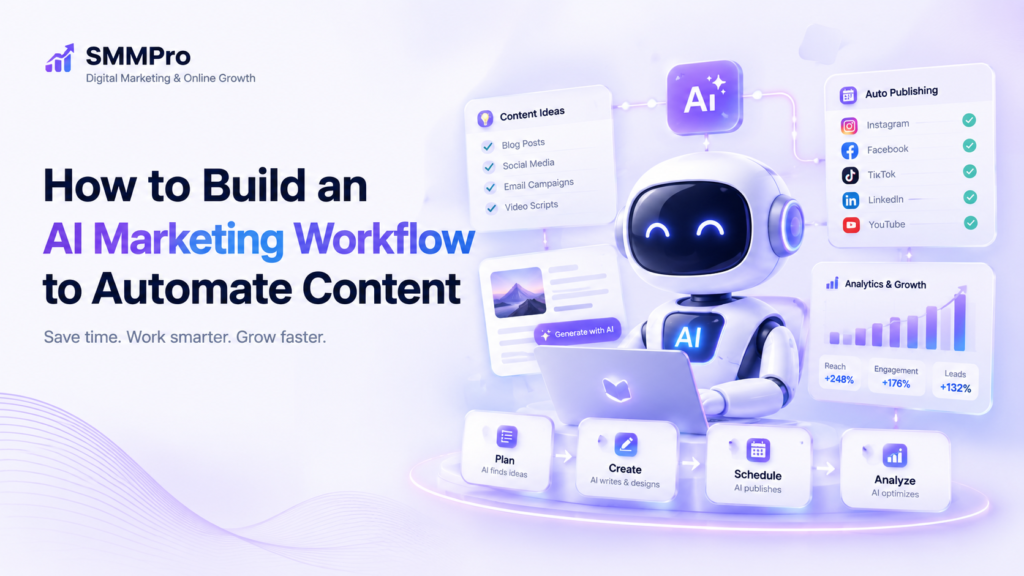

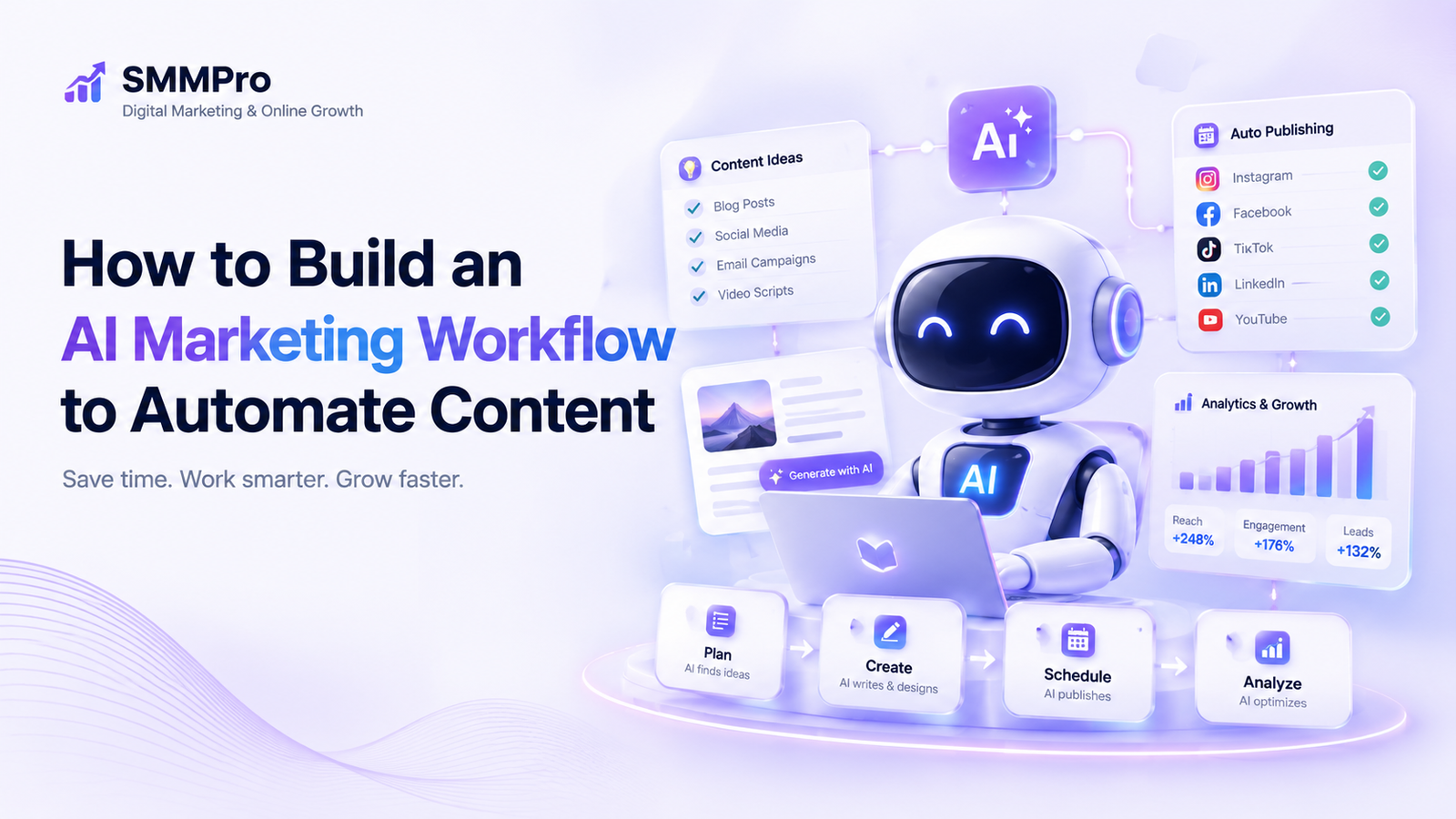
Creating high-quality content consistently is one of the biggest challenges for modern marketers, freelancers, and business owners. Staying active across blogs, social platforms, and email newsletters often feels like a full-time job on its own. If you want to scale your output without burning out, learning how to build an ai marketing workflow is the single most effective lever you can pull.
An automated system does not mean sacrificing quality or spamming your audience with robotic copy. Instead, a well-designed ai content creation pipeline handles the repetitive grunt work—like brainstorming topics, outlining articles, reformatting posts, and drafting copy—so you can focus on strategy, personal stories, and high-level creativity.
In this comprehensive guide, we will break down step-by-step how to construct an automated content engine from scratch. You will learn how to choose the right tech stack, set up continuous workflows, and maintain strict brand quality every step of the way.
What is an AI Marketing Workflow?
An AI marketing workflow is an end-to-step system that uses artificial intelligence tools to plan, create, reformat, and distribute content with minimal human friction.
Instead of opening a blank document every time you need to write a blog post or social update, an automated workflow moves ideas through a structured assembly line.
[ Ideation & Keyword Research ]
               │
               ▼
   [ Outline & Raw Draft (AI) ]
               │
               ▼
   [ Human Review & Editing ]
               │
               ▼
[ Repurposing & Multi-Channel Distribution ]
Why Manual Content Creation Falls Behind
Time Constraints: Drafting long-form articles manually takes 4 to 6 hours per piece.
Inconsistent Posting: Interrupted schedules hurt organic search rankings and social media reach.
Scalability Bottlenecks: Hiring larger content teams quickly becomes expensive for small businesses.
By automating marketing tasks with ai, you eliminate the start-from-scratch penalty. AI handles 70% of the mechanical effort, while you provide the expert direction and final polish.
Core Components of an Automated AI Marketing Engine
A robust content engine relies on four core operational stages. Every tool and prompt you use should fit neatly into one of these buckets.
       ┌──────────────────────────────────────┐
       │   1. Research & Ideation             │
       │   (Topics, Keywords, Competitors)    │
       └──────────────────┬───────────────────┘
                          │
                          ▼
       ┌──────────────────────────────────────┐
       │   2. Drafting & Generation           │
       │   (Articles, Hooks, Captions)        │
       └──────────────────┬───────────────────┘
                          │
                          ▼
       ┌──────────────────────────────────────┐
       │   3. Design & Asset Creation         │
       │   (Images, Carousels, B-Roll Video)  │
       └──────────────────┬───────────────────┘
                          │
                          ▼
       ┌──────────────────────────────────────┐
       │   4. Distribution & Scheduling       │
       │   (Auto-Posting, Email Campaigns)    │
       └──────────────────────────────────────┘
1. Research & Ideation
Before writing a single word, AI can analyze search trends, find content gaps, and extract high-intent questions from audience communities.
2. Drafting & Copywriting
Using targeted prompts, AI generators produce detailed outlines, blog sections, social hooks, and email newsletter drafts aligned with your audience’s intent.
3. Visual & Multimedia Generation
Complementary tools create custom blog banners, social media carousels, short-form video scripts, and eye-catching graphics automatically.
4. Distribution & Multi-Channel Repurposing
Once your primary piece of content is approved, automated pipelines convert it into multiple secondary assets and schedule them across your channels.
Step-by-Step: How to Build an AI Marketing Workflow
Setting up your automated content pipeline requires thoughtful organization. Follow these five steps to build a reliable engine.
Step 1: Map Your Current Content Process
Document every action you currently take when publishing a piece of content. Identify repetitive tasks that take up unnecessary time, such as:
Topic brainstorming
Social media caption writing
Article reformatting
Image sourcing
Step 2: Select Your Core Tool Stack
You do not need dozens of subscriptions. A lean stack typically includes:
Primary Text Generator: ChatGPT, Claude, or Jasper
Workflow Automation Engine: Zapier or Make
Visual Generator: Midjourney or Canva AI
Scheduling Platform: Buffer, Hootsuite, or Metricool
Selecting versatile ai marketing tools for small business ensures high efficiency while keeping software overhead low.
Step 3: Define Your Brand Style and System Prompts
AI models require strict guidance to sound authentic. Create a dedicated “Brand Context Document” that outlines:
Your target buyer persona
Tone of voice preferences (e.g., authoritative, conversational, practical)
Industry jargon to use or avoid
Examples of top-performing past content
Step 4: Implement an AI Content Batching Workflow
Batch processing is where automation delivers its biggest time savings. Instead of producing one post per day, set aside two hours each week to run an ai content batching workflow:
Generate 10 long-tail topic ideas using research prompts.
Outline and draft three full-length articles.
Automatically generate 15 social posts from those articles.
Review, refine, and queue the content for release.
Step 5: Connect Automation Triggers
Connect your tools using webhooks or automation platforms like Make or Zapier. For instance, saving a finalized blog post in Google Docs can automatically trigger AI to draft a summary email and five distinct social posts in your workspace.
Building a ChatGPT Social Media Workflow
Repurposing long-form assets into social media posts is one of the highest-yield marketing activities. Here is a practical framework for creating a streamlined chatgpt social media workflow.
  [ Long-Form Blog Article ]
              │
              ├──► LinkedIn Thought Leadership Post
              │
              ├──► X (Twitter) Thread
              │
              ├──► Instagram Carousel Copy
              │
              └──► Short-Form Video Script (TikTok/Reels)
Prompt Template: Long-Form to Multi-Platform Assets
Prompt:
“Act as a senior social media strategist. Analyze the provided blog article and generate the following four assets matching our brand voice [Insert Voice Parameters]:
A 200-word LinkedIn post focused on a counterintuitive takeaway, ending with a conversation-starting question.
A 5-tweet X thread summarizing the core steps with concise, punchy bullet points.
An Instagram carousel script with 6 slide slides (Slide 1: Hook, Slides 2-5: Value points, Slide 6: Call to Action).
A 30-second video script for TikTok/Reels featuring a short hook, visual cues, and plain spoken dialogue.”
This single prompt transforms one comprehensive piece of content into a multi-platform strategy in seconds.
Essential AI Marketing Automation Tools Comparison
| Tool Name | Core Strengths | Best Used For | Setup Difficulty |
|---|---|---|---|
| ChatGPT (Plus) | Versatile text generation, custom GPTs | Drafting, brainstorming, coding prompts | Low |
| Claude AI | Nuanced writing, handling long context | Long-form writing, deep research analysis | Low |
| Make.com | Visual automation, deep API connections | Complex multi-app workflows | Moderate |
| Zapier | Simple app integrations, broad support | Instant trigger-action automation | Easy |
| Jasper AI | Team collaboration, voice templates | Enterprise campaigns, ad copy | Low |
| Canva Magic Studio | Graphic design, visual asset creation | Social images, slide decks, banners | Easy |
Real-World Case Study: 300% Content Output Growth
An agency client specializing in B2B consulting needed to scale their search visibility and social authority without expanding their two-person team.
The Solution
We implemented a structured ai lead generation automation pipeline integrated with their publishing stack:
[ Keyword Research System ] ──► [ AI Content Pipeline ] ──► [ Human Editorial Review ] ──► [ Auto-Distribution ]
The Results After 90 Days
Weekly Output: Increased from 1 article per week to 4 fully optimized guides.
Organic Traffic: Increased by 185% due to broader keyword coverage.
Lead Generation: Inbound contact requests grew by 42% via automated newsletter funnel sequences.
Time Saved: The team cut content creation time from 20 hours down to 5 hours per week.
Expert Tips for Maintaining Brand Quality
Automated workflows fail when teams rely entirely on raw AI output. To consistently publish high-ranking, valuable content, follow these practical quality guidelines:
Always Keep a Human in the Loop: Never set up direct AI-to-publishing pipelines without editorial review. A human editor must check facts, refine brand tone, and verify claims.
Inject Proprietary Data and Stories: AI cannot replicate personal experiences, internal company metrics, or unique client stories. Add these elements manually to build trust and original authority.
Optimize for Search Intent: Ensure your finished draft answers the specific questions readers are searching for on Google.
Check Formatting and Scannability: Break up text with short paragraphs, clean bullet points, and helpful tables so mobile readers can skim easily.
Conclusion
Learning how to build an ai marketing workflow is essential for modern content creation. By combining structured prompts, intelligent automation, and human editorial oversight, you can produce consistent, high-converting content without burning out your team.
Start small: pick a single channel, build an automated repurposing sequence, and refine your prompts. Once your core pipeline is running smoothly, expand your automation to cover email marketing, lead generation, and multi-channel publishing.
Ready to transform your organic growth strategy? Explore our full library of digital marketing guides and automation strategies on SMMPro today!
FAQ
FAQs about How to Build an AI Marketing Workflow to Automate Content Creation
An AI marketing workflow is an automated system that connects content research, drafting, asset creation, and multi-channel publishing using artificial intelligence software. It works by passing data seamlessly between specialized tools via webhooks or API triggers, eliminating manual execution bottlenecks. Human editors oversee the output to guarantee factual accuracy, brand alignment, and strategic value before content goes live.
To build an AI content creation pipeline for a small business, start by mapping your current content creation steps and selecting an integrated tool stack like Claude for drafting, Make for automation, and Buffer for scheduling. Next, build brand prompt templates and establish automated triggers so a single blog post automatically generates social captions, email drafts, and visual assets, saving up to 15 hours weekly.
You can automate a social media repurposing workflow with ChatGPT by feeding a finalized long-form article into a structured multi-asset prompt. The system prompt instructs ChatGPT to convert the core takeaways into LinkedIn posts, X (Twitter) threads, Instagram carousel copy, and short-form video scripts. Connecting ChatGPT to automation platforms like Zapier transfers these outputs directly into your social scheduling calendar.
No, using an AI marketing workflow will not hurt your Google search rankings as long as your published content is accurate, original, and valuable to readers. Google’s Search guidelines prioritize content quality and user intent satisfaction over the tools used for creation. However, publishing unedited, thin, or low-quality AI text without human editorial review can lead to quality demotions.
You measure the ROI of an automated AI content creation pipeline by evaluating time saved per publication, total content volume increase, organic search traffic growth, and customer acquisition cost reduction. For example, cutting article creation time from 20 hours to 5 hours while quadrupling your publishing frequency demonstrates direct operational savings while accelerating search engine index coverage and lead capture.
Make.com is generally better than Zapier for complex, multi-branching AI marketing workflows because it offers visual data mapping and lower operational costs at scale. Zapier is simpler for beginners who need straightforward, two-step integrations between common apps. High-volume marketing teams typically prefer Make for building multi-tool content creation pipelines due to its advanced data handling and cost-effective pricing structure.
AI marketing automation generates leads by converting high-ranking informational blog articles into targeted email sequences, downloadable lead magnets, and platform-specific social posts automatically. By connecting AI generation pipelines to your customer relationship management (CRM) software, digital marketing platforms like SMMpro can nurture site traffic instantly, converting casual readers into high-intent sales inquiries with minimal manual intervention.
AI content batching is the operational strategy of researching, drafting, and scheduling multiple weeks of content in a single dedicated work block using pre-built prompts and templates. Rather than creating posts on a daily basis, marketers spend two hours generating structured outlines and social copy simultaneously. This approach eliminates daily decision fatigue and ensures consistent multi-channel publishing schedules.
You maintain a consistent brand voice across automated content by providing AI models with a comprehensive Brand Context Document during the prompting phase. This document details your audience demographics, tone guidelines, core messaging pillars, forbidden terms, and top-performing content examples. Embedding these rules into custom GPTs or automation templates ensures generated drafts align with your brand before human review.
Building an AI marketing workflow in-house is suitable if your team has the technical bandwidth to manage prompts, webhooks, and editorial quality, but partnering with an agency like SMMpro delivers faster execution and proven ROI. Specialized agencies provide ready-to-use automation architectures, custom AI brand models, and professional editorial oversight, helping businesses scale organic visibility without costly implementation mistakes.