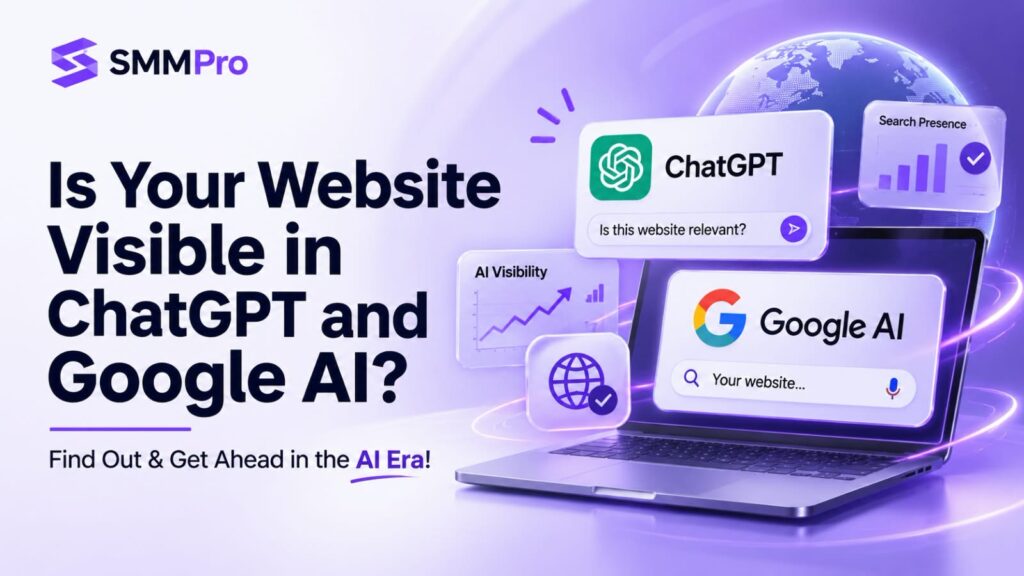
Is Your Website Visible in ChatGPT and Google AI? A Guide to AI Search Visibility
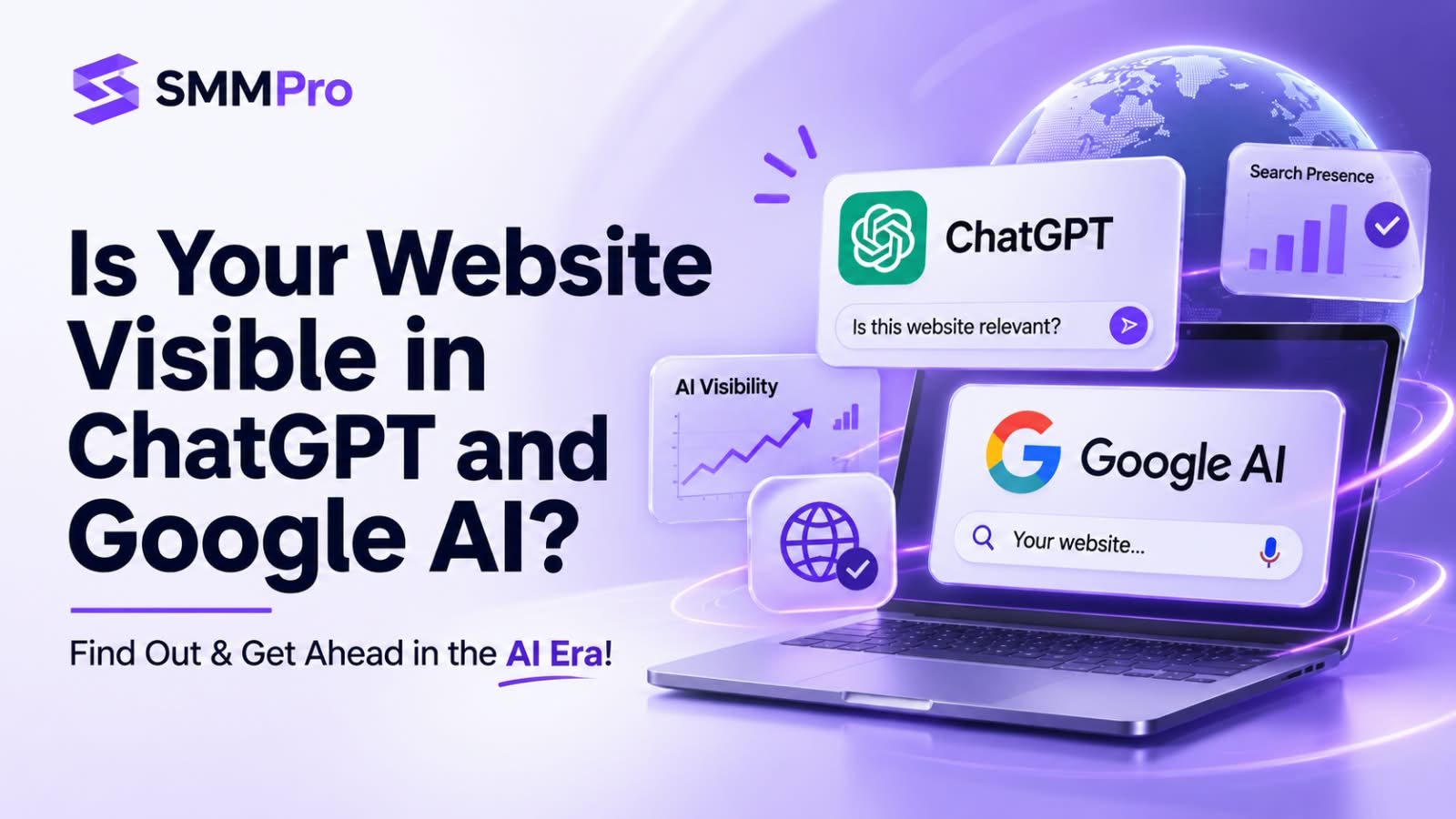
Search is changing. People no longer rely only on Google to find information, compare products, or discover businesses. They increasingly ask questions through AI-powered platforms such as ChatGPT, Google AI Overviews, Gemini, and Perplexity.
For website owners and digital marketers, this creates a new challenge: Is your website appearing when potential customers ask AI tools questions related to your business?
This is where AI search visibility becomes important. By combining traditional SEO with Generative Engine Optimization (GEO), businesses can improve their chances of being discovered, mentioned, and cited in AI-generated answers.
In this guide, you’ll learn how AI search visibility works, how to check your website’s presence, which tools can monitor it, and how to improve your online visibility.
1. What Is AI Search Visibility?
AI search visibility refers to how frequently a website or brand appears in AI-generated search answers.
Unlike traditional search engines that primarily display website links, AI platforms can summarize information, recommend businesses, compare products, and provide links to supporting sources.
For example, someone might ask ChatGPT:
What are the best SEO tools for beginners?
Which digital marketing agencies help small businesses?
How can I improve my Instagram marketing?
If an AI-generated answer mentions your business or links to your article, your website has gained AI search visibility.
It generally includes three outcomes:
Brand mentions: AI platforms mention your business.
Website citations: AI answers link to your website.
AI referral traffic: Users visit your website through AI-generated links.
These outcomes are related but not identical. A brand can receive mentions without getting website visits.
2. Is Your Website Visible in ChatGPT and Google AI?
Yes. Websites can appear in ChatGPT search results and Google AI Overviews, but inclusion is not guaranteed.
ChatGPT Search
ChatGPT Search retrieves relevant information from the web and can provide answers with links to supporting websites.
OpenAI uses a crawler called OAI-SearchBot to discover websites for ChatGPT search.
Website owners should:
Allow OAI-SearchBot to access relevant pages.
Ensure their hosting provider does not block its published IP addresses.
Publish useful, accessible content.
Maintain technically healthy website pages.
OAI-SearchBot and GPTBot have different purposes. OAI-SearchBot supports search discovery, while GPTBot relates to content potentially used for model training. Blocking GPTBot does not automatically block ChatGPT search visibility.
Google AI Overviews
Google AI Overviews displays AI-generated summaries within Google Search, alongside links to relevant websites.
Google explains that pages must be indexed and eligible to appear in regular Google Search to qualify as supporting links in AI Overviews.
There is no separate AI schema or guaranteed ranking technique. Existing SEO fundamentals remain important.
3. How ChatGPT and Google AI Find Website Information
AI search platforms use several processes to discover and retrieve website information.
1. Crawling: Search crawlers visit publicly accessible web pages. Google uses Googlebot, while OpenAI uses OAI-SearchBot for search discovery.
2. Indexing: Search engines process and organize discovered information so relevant pages can be retrieved later.
3. Search retrieval: When someone asks a question, the platform retrieves potentially relevant information from available sources.
4. Source selection: Relevance, content usefulness, accuracy, and source reliability can influence which information is selected.
5. Answer generation: The AI system combines relevant information into an answer and may provide links to supporting websites.
Importantly, appearing in ChatGPT search is not the same as having website content used for AI model training.
4. How to Check If Your Website Appears in AI Search Results
You can start monitoring AI search visibility without purchasing expensive software.
Search Relevant Questions in ChatGPT
Test questions related to your industry, products, and services.
For example:
Which websites provide beginner-friendly SEO guides?
What are the best digital marketing resources for small businesses?
Where can I learn about AI marketing tools?
Check whether ChatGPT mentions your brand or cites your website.
Test Different Search Queries
Try different versions of the same question. Users may search for affordable SEO tools, SEO software for freelancers, or free website optimization tools.
This helps identify topics where your website has stronger visibility.
Check Google AI Overviews
Search relevant keywords on Google and examine whether AI Overviews appear. Check their supporting links to see whether your website is included.
Monitor Website Traffic
Use Google Analytics 4 (GA4) to investigate referral traffic from AI platforms.
ChatGPT search automatically adds the utm_source=chatgpt.com parameter to referral URLs, making incoming traffic easier to identify.
Use Google Search Console
Google Search Console helps monitor website indexing, impressions, clicks, and search performance.
Use it alongside manual AI search testing to understand your website’s overall search presence.
Remember that AI responses can change depending on the query, location, and time.
5. Best Tools to Track AI Search Visibility
Several platforms help businesses monitor AI mentions, website citations, and competitor visibility.
Tool | Main Purpose | Access |
|---|---|---|
| Google Search Console | Monitor Google search performance, impressions, clicks, and indexing. | Free |
| Semrush AI Visibility Toolkit | Track AI mentions, brand visibility, and competitor performance. | Limited free access; paid plans |
| Ahrefs Brand Radar | Monitor brand mentions and visibility across AI search platforms. | Paid |
| Profound | Analyze AI search visibility, brand mentions, and website citations. | Paid plans |
Google Search Console
Google Search Console is an essential starting point for website owners. It helps identify indexing issues and monitor traditional Google search performance.
Best for: Bloggers, beginners, and small businesses.
Semrush AI Visibility Toolkit
Semrush provides AI visibility analysis, competitor research, brand monitoring, and prompt tracking.
Best for: SEO professionals and digital marketing agencies.
Ahrefs Brand Radar
Ahrefs Brand Radar helps businesses investigate brand mentions, AI citations, and competitor visibility.
Best for: SEO teams interested in brand and competitor research.
Profound
Profound focuses on AI search analytics, including brand visibility, citations, sentiment, and prompt research.
Best for: Growing businesses and agencies.
Features and prices vary by subscription. Start with free tools and consider paid platforms when you need more detailed reporting.
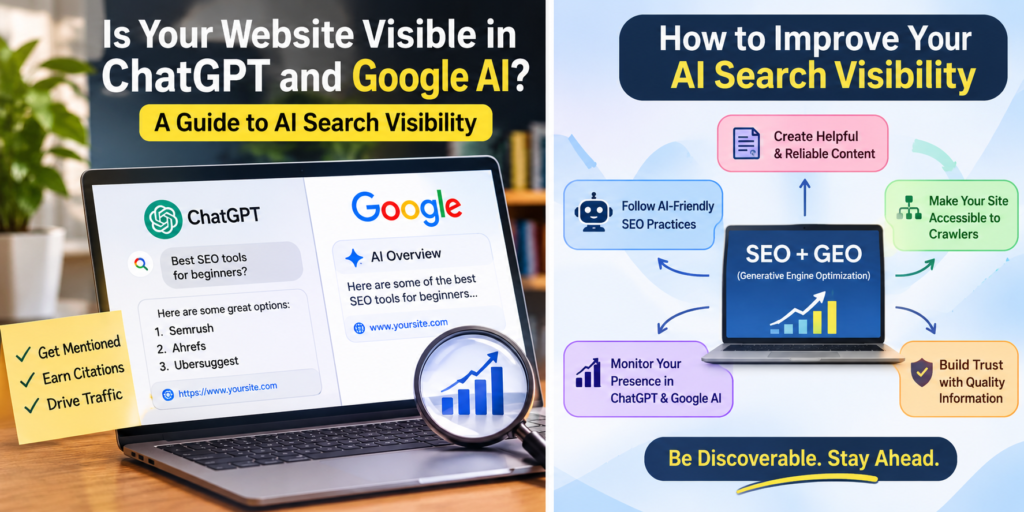
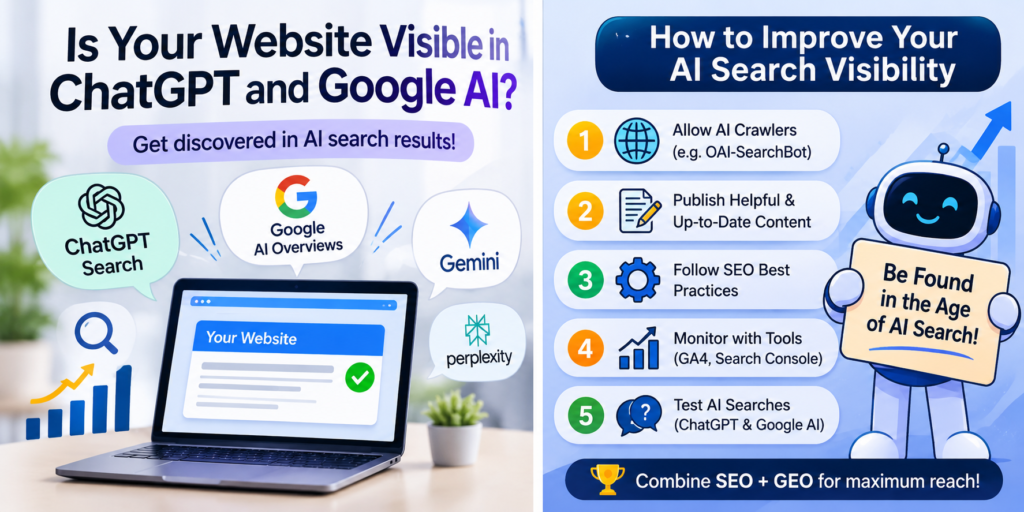
6. How to Improve Your Website’s Visibility in ChatGPT and Google AI
Improving AI search visibility requires a combination of traditional SEO, helpful content, and brand credibility.
1. Publish Helpful, Original Content
Create articles that solve real problems instead of repeating information already available everywhere.
Include practical examples, useful explanations, and actionable recommendations.
2. Answer Specific User Questions
Create content around questions your audience actually searches for.
For example:
How can small businesses improve SEO?
Which social media platform is best for beginners?
How do I connect Meta Pixel with WooCommerce?
Answer the main question clearly before expanding into supporting details.
3. Use Clear Headings
Organize content with descriptive H2 and H3 headings. Clear sections make information easier for readers to navigate.
4. Build Topical Authority
Publish interconnected articles around your main niche.
A digital marketing website could cover SEO, keyword research, content marketing, AI tools, and social media optimization.
Connect related articles through internal links.
5. Use Credible Sources
Support important claims with official documentation, reliable research, and verified statistics. Avoid unsupported statements.
6. Improve Website Structure
Use descriptive URLs, logical categories, XML sitemaps, and relevant internal links to make important pages easier to discover.
7. Maintain Accurate Business Information
Keep your business name, contact information, services, and website details consistent across relevant online platforms.
8. Build Brand Mentions
Develop a trustworthy online presence through industry publications, genuine reviews, professional partnerships, and useful social media content.
9. Check Crawler Access
Review your robots.txt file and server settings. Make sure Googlebot and OAI-SearchBot can access the pages you want discovered.
10. Use Structured Data Correctly
Use relevant Schema.org types such as Article, Organization, Product, and LocalBusiness where appropriate.
Structured data helps search engines understand your content, but special AI schema does not guarantee citations.
| Comparison | Traditional SEO | Generative Engine Optimization (GEO) |
|---|---|---|
| Main Objective | Improve search engine rankings. | Improve visibility in AI-generated answers. |
| Platforms | Google and Bing. | ChatGPT Search, Google AI Overviews, Gemini, and Perplexity. |
| Main Focus | Organic rankings, traffic, and clicks. | Brand mentions, AI visibility, and website citations. |
| Content Strategy | Keywords, search intent, and relevant content. | Clear answers, useful information, and credible sources. |
| Measurement | Rankings, impressions, clicks, and organic traffic. | AI mentions, citations, visibility, and referral traffic. |
GEO does not replace traditional SEO. A website with helpful content, strong technical foundations, and clear structure has a better foundation for AI search discovery. Combining both strategies helps businesses improve their visibility across traditional search engines and AI-powered platforms.
8. Common Mistakes That Reduce AI Search Visibility
Avoid these mistakes when developing your AI search strategy:
Generic content: Publishing repetitive articles without useful information.
Ignoring SEO: Neglecting indexing, website structure, and technical issues.
Unsupported claims: Using unverified statistics and misleading information.
Poor formatting: Creating pages without descriptive headings.
Blocking crawlers: Accidentally restricting important search bots.
Focusing only on rankings: Ignoring AI mentions and citations.
Expecting guaranteed results: No strategy guarantees AI recommendations.
Focus on useful content, technical accessibility, and trustworthy information.
9. How Small Businesses Can Build AI Search Visibility
Small businesses do not need expensive subscriptions to start improving their AI search presence.
Follow this practical approach:
Choose a niche: Focus on a specific audience and industry.
Publish helpful articles: Answer customer questions through useful content.
Build brand credibility: Maintain accurate business profiles and share relevant information.
Improve SEO: Use Google Search Console to monitor website performance.
Test AI visibility: Search relevant questions in ChatGPT and Google.
Update content: Improve existing articles and address missing information.
Consistency and content quality matter more than purchasing several expensive tools.
10. How to Measure AI Search Visibility Over Time
Monitor these indicators to understand your progress and identify opportunities to improve your website’s visibility across AI-powered search platforms.
| Metric | What It Measures |
|---|---|
| Brand Mentions | How frequently AI-generated answers mention your business or brand. |
| Website Citations | How often AI answers include links to your website pages. |
| AI Referral Traffic | Visitors arriving from AI platforms such as ChatGPT and Perplexity. |
| Organic Impressions | How often your website appears in traditional Google search results. |
| Branded Searches | How frequently people search for your business or brand name. |
| Conversions | Leads, sign-ups, and purchases generated by AI-referred visitors. |
Create a Monthly AI Visibility Monitoring Routine
Follow these steps every month to track changes and identify areas for improvement:
- Test relevant questions: Search 10–20 questions related to your industry across selected AI platforms.
- Record brand mentions: Note when your business appears in AI answers and whether your website is cited.
- Compare competitors: Check which competing websites and brands appear for the same questions.
- Review analytics: Use Google Search Console and Google Analytics 4 (GA4) to monitor organic performance and referral traffic.
- Improve your content: Update existing articles, add useful information, and address gaps identified during monitoring.
Important Tip: AI-generated responses can change depending on the query, location, platform, and time. Use consistent questions and testing conditions each month to make meaningful comparisons.
Frequently Asked Questions
1. How do I know if my website appears in ChatGPT?
Search relevant questions in ChatGPT and check whether your website or brand appears in its answers and citations.
2. How can I get my website mentioned in ChatGPT?
Publish useful content, build brand credibility, and allow OAI-SearchBot to access your website. These practices improve discoverability but do not guarantee mentions.
3. Does Google AI Overview use websites from Google Search?
Yes. Google AI Overviews can use relevant pages indexed and eligible to appear in Google Search.
4. What is AI search visibility?
It describes how frequently your brand or website appears in AI-generated answers through mentions and citations.
5. Is GEO different from traditional SEO?
Yes. SEO focuses on search engine visibility, while GEO focuses on visibility in AI-generated answers. Both benefit from useful content and strong website foundations.
6. Can I track website traffic from ChatGPT?
Yes. Google Analytics 4 can help identify ChatGPT referral traffic using the utm_source=chatgpt.com parameter.
7. Does ChatGPT Search use Google rankings?
You should not assume ChatGPT Search simply copies Google’s rankings. OpenAI operates its own search functionality and retrieval processes.
8. How long does it take to improve AI search visibility?
There is no fixed timeline. Results depend on website accessibility, content quality, competition, and how AI platforms discover information.
Conclusion
AI-powered search is changing how people discover businesses and online information. Traditional Google rankings remain important, but website owners should also understand how their brands appear in ChatGPT and Google AI Overviews.
Improving AI search visibility starts with helpful content, technical SEO, topical authority, and a trustworthy online presence.
Start with free tools such as Google Search Console and GA4, test relevant questions in ChatGPT, and introduce specialized monitoring platforms as your website grows.
Don’t focus only on ranking in search results. Build a website that provides information worth discovering, mentioning, and citing.