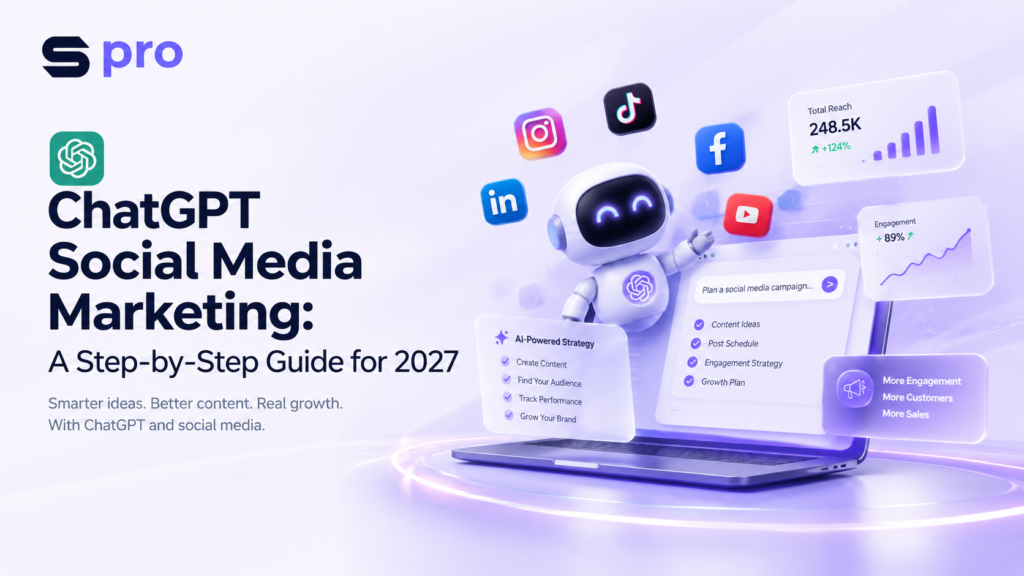
Most people use ChatGPT for social media marketing the wrong way. They type “write me an Instagram caption about coffee,” get something generic, and decide the tool isn’t very good.
The tool isn’t the problem. The brief is. ChatGPT social media marketing works when you treat it like a junior strategist: you give it context, a clear job, and feedback. If you’re planning your 2027 content strategy, this guide gives you a repeatable workflow with prompts you can copy and adapt.
What ChatGPT Can (and Can’t) Do for Social Media
ChatGPT is a language model. It’s strong at speed, structure, and variation. It’s weak at knowing your audience, your brand history, and what happened on social media this morning.
| Good use | Poor use |
|---|---|
| Brainstorming social media content ideas with AI | Publishing first drafts untouched |
| Turning one idea into five formats | Quoting statistics without checking them |
| Rewriting a caption in different tones | Replacing real customer insight |
| Building content calendars and outlines | Posting about breaking news |
| Summarizing comments and feedback you paste in | Making claims about competitors without evidence |
Think of it as a drafting partner. You supply the judgment.
Step 1: Give ChatGPT Your Brand Context First
Generic input produces generic output. Before asking for any post, set up a reusable brand brief.
Include:
- What your business sells and to whom
- Your audience’s main problems and goals
- Your tone of voice (with 2–3 sample posts you like)
- Words and claims to avoid
- Your platforms and posting goals
Prompt example:
“You are a social media strategist for a small bakery in Lahore that sells custom cakes. Our audience is women aged 22–40 planning birthdays and weddings. Our tone is warm, playful, and never salesy. We avoid exclamation-heavy hype. Summarize this as a brand brief I can reuse.”
Save the result. ChatGPT offers features for keeping context, such as Projects, memory, and custom instructions. Projects keep related work together, and memory stores preferences across conversations. Features and plan limits change often, so check what your account offers.
If you work with clients, keep one project or saved brief per client so brand voices never mix.
Step 2: Research Your Audience and Competitors
ChatGPT can’t see your analytics, so feed it real data. Paste in:
- Comments from your best-performing posts
- Customer reviews
- Common questions from DMs
- Competitor captions (for analysis, not copying)
Prompt example:
“Here are 40 comments from our last three posts. Group them into themes, list the top five questions people ask, and suggest one content idea for each.”
This turns scattered feedback into a content plan grounded in what your audience actually says.
Step 3: Build a Content Strategy and Pillars
Content pillars are the three to five topics your account consistently covers. They keep your feed focused.
Prompt example:
“Using the brand brief above, suggest four content pillars for Instagram and TikTok. For each pillar, give the goal (awareness, trust, or sales), three post formats, and one example idea.”
A bakery might land on: behind-the-scenes baking, cake planning tips, customer stories, and seasonal offers. Drop any pillar you can’t sustain for three months.
Step 4: Generate Content Ideas in Batches
Ask for ideas with constraints. Vague requests give vague ideas.
Prompt example:
“Give me 20 Reel ideas for the ‘cake planning tips’ pillar. Each needs a hook for the first three seconds, a one-line description, and a call to action. No ideas that require expensive equipment.”
Then filter. Shortlist the five ideas you could film this week and discard the rest.
Step 5: Write Posts That Sound Like You
This is where most AI social media content goes wrong. Raw output often sounds smooth but empty. Fix it with three habits.
1. Show it your voice. Paste two or three real captions and say: “Match this tone and sentence length.”
2. Ask for options. Request three versions with different hooks: a question, a bold claim, and a short story.
3. Edit with specifics. Replace generic lines with real details: a customer’s name (with permission), a price, a local reference, a mistake you made.
Before and after example
Generic draft:
“Planning a birthday? Our custom cakes are made with love and quality ingredients.”
After adding specifics:
“A 9-year-old asked for a cake shaped like her pet parrot. Took us two days and a lot of green fondant. Here’s how it turned out.”
The second version wins because it’s specific, which no tool can invent for you.
Step 6: Adapt One Idea Across Platforms
Give ChatGPT one core idea and ask for platform-native versions.
Prompt example:
“Turn this blog paragraph into: a LinkedIn post (professional, 120 words), an Instagram caption (casual, with 5 hashtags), a TikTok script (30 seconds, hook first), and an X thread (4 posts).”
| Platform | What to adjust |
|---|---|
| Longer, insight-led, first line matters | |
| Visual-first captions, clear call to action | |
| TikTok | Spoken hook, fast pacing, on-screen text |
| X | Short, opinionated, thread-friendly |
| Community tone, questions that invite replies |
Don’t post identical text everywhere. Each platform has its own habits.
Step 7: Plan a 2027 Content Calendar
Once you have pillars and ideas, build a schedule. Planning ahead works well for annual events, so ask for a quarter at a time.
Prompt example:
“Create a four-week content calendar for Instagram and TikTok starting in January 2027. Post four times a week. Balance the pillars: 40% education, 30% behind-the-scenes, 20% social proof, 10% offers. Output as a table with date, platform, format, topic, and hook.”
Paste the table into your scheduling tool and adjust dates around real events such as holidays, launches, and local occasions. Confirm exact festival dates yourself, since some follow lunar calendars.
Step 8: Improve Posts After Publishing
Paste in your metrics (reach, saves, shares, watch time) for several posts and ask:
“Here are results for 10 posts. Identify patterns in hooks, formats, and topics. What should we do more or less of? Flag anything you can’t conclude from this little data.”
That last sentence matters. With a small sample, patterns can be coincidence.
12 ChatGPT Marketing Prompts You Can Use Today
- “Write 10 hook options for a post about [topic] aimed at [audience].”
- “Rewrite this caption in a friendlier tone, under 80 words.”
- “Turn these customer reviews into three testimonial-style posts.”
- “Suggest 15 questions my audience asks about [topic] that I could answer in short videos.”
- “Create a 30-second video script with a hook, three points, and a call to action.”
- “List 10 myths about [industry] and a one-line correction for each.”
- “Draft five replies to this negative comment, ranging from empathetic to firm.”
- “Give me a content series idea with a repeatable format for [niche].”
- “Write alt text for these five images.”
- “Suggest A/B test ideas for this caption.”
- “Turn this webinar transcript into five short posts.”
- “Create a checklist of what to review before publishing this post.”
ChatGPT Marketing Examples by Business Type
Freelance designer: Pastes three client case studies and asks for a LinkedIn carousel outline for each, focused on the problem, process, and result.
Local gym: Feeds in common member questions and generates a 30-day Reel series answering one question per day.
E-commerce store: Uploads product descriptions and asks for five short-form video scripts that show the product solving a specific problem.
Agency: Keeps a separate saved brief per client and uses one structured prompt each Monday to draft the week’s content for review.
Social Media AI Tools to Combine With ChatGPT
ChatGPT handles text well. A full workflow usually needs more:
- Design tools for graphics and carousels
- Video editors with captioning features
- Scheduling platforms for publishing and analytics
- Social listening tools for trends and brand mentions
Choose tools based on your bottleneck. If writing is slow, use ChatGPT. If video editing is slow, solve that first.
How to Prepare Your Strategy for 2027
Nobody can say exactly how platforms or AI tools will look in 2027. You can still build a strategy that holds up whatever changes:
- Expect faster tool changes. ChatGPT has changed its models, features, and plans many times in a short period. Save your prompts and brand brief in a document you control, so you can move them if a feature changes or disappears.
- Expect more AI-generated content in every feed. Generic posts will blend in. Original experience, real faces, and specific stories will matter more.
- Expect tighter disclosure rules. Platforms already ask for labels on realistic synthetic media. Build a habit of checking policies each quarter.
- Review quarterly. Rerun your audience research prompt every three months with fresh comments and data.
Rules You Should Follow: Disclosure and Accuracy
Meta, YouTube and TikTok ask creators to label realistic AI-generated or altered content. YouTube asks for labels on content that is altered or synthetic and looks realistic or meaningful. TikTok requires labels on realistic AI-generated images, audio and video, and uses Content Credentials metadata to help detect it.
Those rules mainly target realistic synthetic media, not ordinary caption brainstorming. Policies change, though, so read each platform’s current guidelines. Also:
- Verify every statistic, price, and claim before posting
- Don’t invent testimonials or reviews
- Follow advertising rules in your country, especially for health, finance, and income claims
- Never paste confidential client data into tools you haven’t vetted
Common Mistakes to Avoid
- Skipping context. No brand brief, no useful output.
- Publishing raw drafts. Audiences spot generic copy quickly.
- Asking for one idea instead of twenty. Volume gives you something to filter.
- Trusting invented facts. Language models can state wrong information confidently.
- Copying competitors. Use their posts to understand patterns, not to rewrite them.
- Ignoring analytics. Prompts improve only when you feed back what worked.
- Using the same prompt forever. Refine it based on results.
Key Takeaways
- ChatGPT social media marketing works best as a drafting and planning partner, not an autopilot.
- Start with a reusable brand brief, then move through strategy, ideas, drafting, repurposing, and review.
- Specific details from your real business make AI social media content stand out.
- Feed it real audience data and real results, and ask it to flag uncertainty.
- Verify facts, follow each platform’s AI disclosure rules, and review your approach every quarter.
Conclusion
ChatGPT social media marketing isn’t about pressing a button and posting. It’s a workflow: give context, ask better questions, edit with real details, and learn from results. As you plan 2027, start small. Build your brand brief, generate one week of ideas, publish, and review what happened. Then refine your prompts and repeat.
Used this way, ChatGPT saves hours of planning and drafting while the human parts of your brand stay yours.