Search behavior has changed faster in the last two years than in the previous decade. Customers no longer scroll through ten blue links to compare local services or software tools. Instead, they ask ChatGPT, Perplexity, or Google AI Overviews for a direct recommendation—and trust the single answer they get.
If your business does not appear in those generated summaries, you are invisible to a massive segment of ready-to-buy customers. Knowing how to optimize a website for AI search is no longer an optional experiment for enterprise tech brands. It is a survival skill for small businesses.
The good news? You do not need a massive marketing budget to compete. AI engines prioritize clarity, real-world experience, and structured facts over sheer domain size. In this practical generative engine optimization guide, you will learn the exact steps to make your website the source AI tools quote, cite, and recommend.
Key Takeaways
AI search rewards direct answers: Large Language Models (LLMs) extract concise, factual definitions rather than keyword-stuffed fluff.
GEO and AEO build on SEO: You still need fast technical performance, but your formatting must shift toward entity clarity and structured data.
Brand mentions matter as much as links: Being cited on Reddit, industry directories, and niche blogs trains AI models to trust your business.
What Is AI Search Optimization (GEO & AEO)?
AI search optimization is the process of structuring your website content, technical code, and online reputation so artificial intelligence platforms understand, trust, and cite your brand in generated answers.
Two core frameworks power this approach:
Answer Engine Optimization (AEO): Formatting your pages to provide immediate, clear answers to specific user questions. AEO targets voice assistants, featured snippets, and direct Q&A prompts.
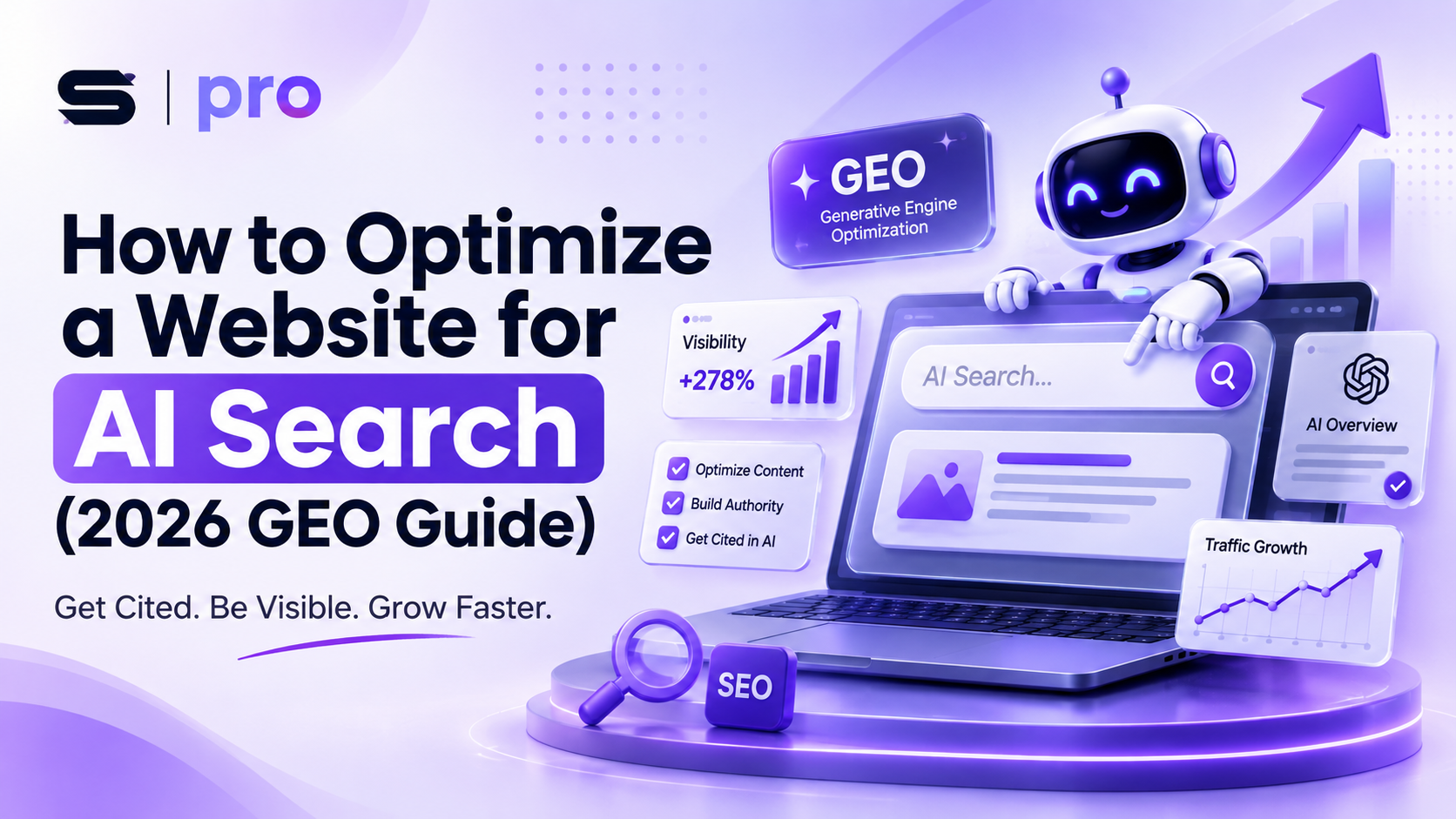
Generative Engine Optimization (GEO): Optimizing deeper content, statistics, and brand authority so conversational engines—like ChatGPT Search, Google Gemini, Perplexity AI, and Claude—synthesize your insights into multi-part recommendations.
Think of traditional search like a library index card that points users to a book. AI search acts like a research assistant who reads the books, summarizes the best advice, and tells the user which author to hire.
GEO vs SEO: Key Differences Small Businesses Must Know
| Ranking Factor | Traditional SEO | Generative Engine Optimization (GEO) |
|---|---|---|
| Primary Goal | Rank #1 on search engine results pages (SERPs) | Become a cited source inside AI-generated answers |
| Content Style | Comprehensive, keyword-targeted articles | Concise, fact-dense answers backed by clear examples |
| Keyword Strategy | Exact-match and long-tail search queries | Natural conversational prompts and semantic entities |
| Authority Signals | High-authority backlinks | Brand mentions, reviews, citations, and original data |
| Success Metric | Organic clicks and impressions | Citation frequency, brand visibility, and referral leads |
How AI Search Engines Choose Which Websites to Cite
To get cited in Google AI Overviews or ChatGPT, you need to understand Retrieval-Augmented Generation (RAG). When a user asks a question, the AI searches the live web for relevant passages, evaluates the trustworthiness of those sources, and writes a summary.
Industry studies analyzing thousands of AI citations show three patterns consistently drive selections:
Information Gain: AI engines skip pages that merely repeat consensus advice. Pages containing original statistics, firsthand steps, or unique frameworks get cited up to 40% more often.
Entity Clarity: Models look for clear relationships between who you are (your brand), what you offer (your service), and where you operate.
Cross-Web Consensus: If Reddit threads, industry blogs, and directory profiles all describe your business consistently, AI models treat your site as a verified authority.
Step-by-Step: How to Optimize a Website for AI Search
Follow these six actionable steps to build an effective answer engine optimization for small business strategy.
1. Write “Answer-First” Paragraphs Under Every Heading
AI crawlers scan headings to match user prompts, then extract the immediate text underneath. Avoid long, poetic introductions before answering the core question.
Weak approach: “When thinking about email marketing costs, every business is different and there are many factors to consider before choosing a plan…”
Strong AEO approach: “Small businesses spend an average of $30 to $150 per month on email marketing software, depending on subscriber count and automation features.”
Place a crisp, 40-to-60-word summary directly beneath every H2 or H3 question. You can expand with nuance and examples right after.
2. Optimize Content for Perplexity AI and ChatGPT Search Prompts
Traditional keyword research focuses on two-to-four-word phrases. Conversational AI queries average 10 to 15 words because users describe their exact situation.
To learn how to rank in ChatGPT search and optimize content for Perplexity AI, map out the follow-up questions your customers ask during sales calls:
Instead of targeting only “CRM software,” create sections answering “What is the best CRM for a 5-person real estate team under $100/month?”
Use natural phrasing inside your subheadings.
Include explicit comparison criteria such as pricing tiers, setup time, and ideal customer profiles.
3. Build Strong Entity Signals and EEAT
Google and AI platforms evaluate Experience, Expertise, Authoritativeness, and Trustworthiness (EEAT) to prevent hallucinations and bad advice.
Strengthen your site’s credibility with these updates:
Add detailed author bios: Include real credentials, years of industry experience, and links to LinkedIn profiles on every blog post.
Publish original mini-studies: Survey 50 customers or share anonymized campaign results from your own business. AI models love quoting primary data.
Upgrade your About page: Clearly state your founding year, physical location, core services, and industry certifications in plain text.
4. Implement Clean Schema Markup (JSON-LD)
Schema markup is behind-the-scenes code that translates your page content into structured facts machines read effortlessly. While schema does not guarantee rankings on its own, it removes ambiguity for search crawlers.
Prioritize these four schema types:
Organization / LocalBusiness Schema: Connects your brand name, logo, address, phone number, and social profiles.
FAQPage Schema: Labels your questions and answers explicitly for answer engines.
Article Schema: Identifies the author, publish date, and last updated date.
Product / Service Schema: Clarifies pricing, availability, and customer review ratings.
5. Check Your robots.txt File for AI Crawlers
Many small business websites accidentally block AI search engines because security plugins restrict unknown bots. While you may want to block bots from scraping your site solely for model training, blocking search retrieval bots removes you from live answers.
Open [yourdomain.com/robots.txt](https://yourdomain.com/robots.txt) and ensure these user agents are allowed to crawl your public pages:
OAI-SearchBot(Powers live search results in ChatGPT)PerplexityBot(Powers citations in Perplexity AI)GooglebotandGoogle-Extended(Powers Google Search and AI Overviews)
6. Earn Brand Mentions on Trusted Third-Party Platforms
AI engines verify your website claims by checking what other websites say about you. You do not always need a clickable dofollow backlink—unlinked brand mentions carry significant weight in LLM training and retrieval.
Focus on three high-impact channels:
Niche industry directories: Keep your Google Business Profile, Clutch, G2, Yelp, or local chamber listings 100% consistent.
Authentic community discussions: Answer real questions helpfully on Reddit, Quora, and industry forums without spamming links.
Digital PR and guest quotes: Contribute expert quotes to journalists via platforms like Connectively or Featured.com.
Real-World Case Study: Local Service Business Winning AI Citations
A regional B2B IT support firm struggled to outrank national tech giants on Google for broad terms like “managed IT services.” Their organic blog traffic had plateaued at 1,200 visits per month.
Instead of chasing high-volume keywords, they revamped ten core service and blog pages using GEO principles:
They added clear pricing breakdown tables to every service page.
They rewrote H2 headings to mirror exact buyer questions (e.g., “How much does HIPAA-compliant IT support cost for a dental clinic?”).
They published a short report analyzing common cybersecurity mistakes across 40 local clinics.
Within four months, the firm became the primary cited source in Google AI Overviews and Perplexity for regional compliance queries. While overall traffic grew by a modest 28%, qualified consultation bookings from organic and AI referral sources doubled.
The Complete AI Search Optimization Checklist
Use this quick AI search optimization checklist before publishing any new page on your website:
[ ] Clear H1 and H2 hierarchy: Headings use natural, question-based phrasing.
[ ] Direct answer block: The first 2–3 sentences under each heading directly answer the question.
[ ] Scannable formatting: Short paragraphs (under 4 lines), bulleted lists, and comparison tables are included.
[ ] Original value: Contains at least one real example, proprietary data point, or step-by-step framework.
[ ] Freshness timestamp: Displays a visible “Last Updated” date with current-year statistics.
[ ] Verified authorship: Includes a named author with relevant industry credentials.
[ ] Schema markup active: Validated JSON-LD code with zero errors in Google’s Rich Results Test.
[ ] Crawler access open:
OAI-SearchBotandPerplexityBotare permitted inrobots.txt.
Expert Tips for Ranking in ChatGPT and Perplexity
Use “Definition + Example” Pairs: Whenever you introduce an industry term, define it in one sentence and immediately follow with “For example…” AI models frequently extract these exact pairs for beginner prompts.
Include Comparative Language: Words like versus, compared to, best for, alternatives, and pros and cons trigger retrieval for high-intent commercial queries.
Update Cornerstone Pages Quarterly: Perplexity and ChatGPT Search heavily favor fresh publication dates for fast-moving topics. Refreshing statistics every 90 days keeps your citations active.
Audit Your Brand Weekly: Open ChatGPT and Perplexity in incognito mode and ask, “What are the best [your service] companies for [your target audience]?” Study which competitors appear and inspect how their pages are structured.
Conclusion
Learning how to optimize a website for AI search gives small businesses a rare window of opportunity. While larger competitors slowly adapt their legacy content strategies, you can capture high-intent customers today by publishing clear, experience-backed answers that AI engines love to quote.
Start small: pick your top five revenue-generating pages, rewrite the headings as real customer questions, add concise answer blocks, and back up your advice with real numbers. Clarity and genuine expertise will always win—whether the reader is a human buyer or an AI search engine.
FAQ
FAQs about How to Optimize a Website for AI Search Engines (GEO & AEO Guide for Small Businesses)
Start by structuring your key service and blog pages with direct, 40-to-60-word answers placed immediately beneath question-based headings. Ensure your robots.txt file and firewall allow AI search crawlers like OAI-SearchBot, PerplexityBot, and Googlebot to access your content. Finally, strengthen your brand trust by keeping your Google Business Profile updated, adding verified author bios, and earning mentions on reputable industry directories.
Traditional SEO focuses on ranking web pages in search engine results to earn clicks, while AEO (Answer Engine Optimization) formats content for direct extraction in voice search and featured snippets. GEO (Generative Engine Optimization) goes further by optimizing facts, statistics, and brand authority so conversational AI models like ChatGPT and Google AI Overviews synthesize and cite your business in generated answers. All three work together, with technical SEO serving as the foundation.
To appear in live AI search citations, allow search retrieval bots including OAI-SearchBot (ChatGPT Search), PerplexityBot (Perplexity AI), Claude-SearchBot (Claude), and Googlebot (Google Search and AI Overviews). You can safely block separate model-training crawlers like GPTBot, ClaudeBot, or Google-Extended if you do not want your content used to train future foundation models, without hurting your live search visibility.
Websites usually miss out on AI citations because of blocked crawlers, thin generic content, or poor entity clarity. Security plugins and CDN firewalls often block AI search bots with 403 errors even when robots.txt looks open. Additionally, AI retrieval systems skip pages that bury answers under long introductions or lack unique data, reviews, and consistent off-site brand mentions.
Yes, schema markup helps AI search engines and crawlers interpret your business details without ambiguity, even though Google notes it is not strictly mandatory for AI Overviews. Implementing clean JSON-LD markup—especially Organization, LocalBusiness, Article, and FAQPage schema—explicitly defines your brand entities, authorship, pricing, and Q&A pairs, making your pages easier for machines to verify and extract.
Use an “answer-first” writing structure where the first two sentences under each H2 or H3 directly answer a specific customer question. Support your explanations with concrete statistics, step-by-step lists, comparison tables, and clear “definition plus example” pairs. Because AI systems extract standalone passages out of context, ensure every section makes complete sense on its own.
Yes, newer websites can earn AI citations faster than traditional top-three Google rankings if they provide superior information gain. AI answer engines prioritize specific, well-structured answers to long-tail buyer questions over domain age alone. By publishing original mini-studies, transparent pricing breakdowns, and niche troubleshooting guides, smaller sites regularly get cited alongside established industry brands.
You can track AI referral traffic in Google Analytics 4 (GA4) by opening the Traffic Acquisition report and filtering by Session source or medium. Look for referral domains such as chatgpt.com, perplexity.ai, gemini.google.com, and claude.ai. Because many AI answers generate zero-click brand awareness, you should also run monthly manual prompt audits across major AI tools to monitor how often your brand is recommended.
Yes, unlinked brand mentions across trusted websites carry major weight in Generative Engine Optimization. Large language models build trust through cross-web consensus rather than relying solely on clickable backlinks. When your business is consistently mentioned in Reddit discussions, niche directories, customer reviews, and digital PR articles, AI engines treat your brand as a verified entity worth recommending.
Small businesses can handle basic on-page AEO updates—like rewriting headings and adding FAQs—in-house, while hiring an agency makes sense for technical audits, schema deployment, and off-site authority building. If your pages suffer from JavaScript rendering issues, CDN bot blocks, or weak topical authority, an experienced digital marketing team like SMMpro can accelerate your visibility across both Google Search and AI answer engines.