What if you could get back hours every week without hiring another person?
For many marketers, the problem isn’t a lack of ideas. It’s the endless execution behind them: researching keywords, writing captions, creating graphics, scheduling posts, following up with leads, and moving information between platforms.
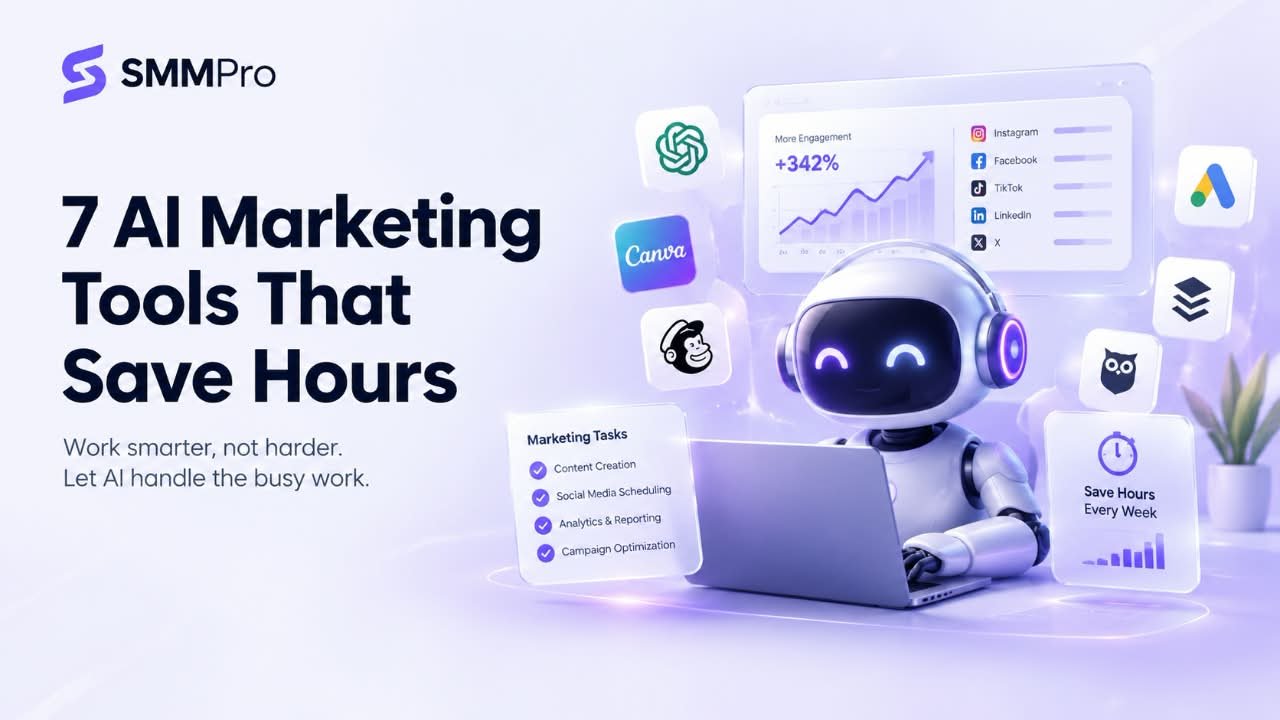
That’s where AI marketing tools can help. This guide covers 7 practical tools that save hours, what each one does, and the limitations to consider.
What Are AI Marketing Tools?
AI marketing tools are software platforms that use artificial intelligence to assist with tasks like creating content, researching keywords, designing visuals, managing social media, and automating workflows.
For example, instead of manually turning one blog post into five social captions, an AI tool can generate several starting points in seconds. You review, edit, and publish the best one.
The goal is not to replace marketers. It is to reduce repetitive work so you can focus on strategy, creativity, and decision-making.
7 AI Marketing Tools That Save Hours:
Tool | Best For | Main Task | Time-Saving Benefit |
|---|---|---|---|
| HubSpot | Marketing automation | CRM and leads | Automates customer workflows |
| Canva | Visual marketing | Graphics | Speeds up design |
| Semrush | SEO | Research and optimization | Reduces manual research |
| Jasper | Content marketing | Marketing copy | Speeds up content production |
| Buffer | Social media | Scheduling | Simplifies publishing |
| Zapier | Workflow automation | App connections | Removes repetitive data entry |
| AdCreative.ai | Paid advertising | Ad creatives | Speeds up creative testing |
1. HubSpot: Best for Marketing Automation
HubSpot is an all-in-one CRM and marketing platform. Its AI features assist with content, email marketing, customer insights, and lead management.
How it saves time: Instead of manually checking every new lead, you can automate follow-ups, lead organization, and customer communication.
Example: A website form submission is added to the CRM, receives a follow-up email, and is assigned to a sales rep automatically.
Best for: Growing businesses, agencies, and marketing teams.
Limitation: The large feature set can overwhelm beginners, and advanced functionality may require paid plans.
2. Canva: Best for Visual Marketing
Canva is a design platform with AI-powered features that help you create and edit visuals without advanced design skills.
How it saves time: Templates and AI-assisted tools let you build social posts, ads, and presentations without starting from scratch.
Example: A small jewelry business creates one branded Instagram template and adapts it for each product.
Best for: Small businesses, freelancers, social media managers, and creators.
Limitation: AI-generated designs often need manual editing to match your brand’s exact look.
3. Semrush: Best for SEO and Content Research
Semrush is widely used for SEO research, competitor analysis, keyword discovery, and content optimization. Its content tools help with topic planning, SEO briefs, and article optimization.
How it saves time: Keyword research, competitor analysis, and content briefs happen in one workflow instead of several separate ones.
Example: A writer researches keywords for a blog post, analyzes competing articles, builds a brief, and optimizes the finished draft in one place.
Best for: SEO professionals, content marketers, and agencies.
Limitation: It can be expensive and complex, which may be excessive for beginners with basic needs.
4. Jasper: Best for Marketing Content
Jasper is an AI platform built to help teams create marketing content with consistent brand messaging, from blog posts to ad copy.
How it saves time: You save brand guidelines once, so you don’t have to re-explain your tone and audience every time.
Example: An agency stores separate guidelines for each client and uses them for captions, ads, and campaign copy.
Best for: Marketing teams, agencies, and businesses producing content regularly.
Limitation: It may be unnecessary if you only need occasional AI writing help.
5. Buffer: Best for Social Media Management
Buffer helps you plan, schedule, and publish content across social channels. Its AI assistant can help generate and adapt post ideas and captions.
How it saves time: You prepare content in batches and schedule it, instead of switching between platforms to post individually.
Example: A freelancer prepares a week of Instagram, Facebook, and LinkedIn posts for a client in one sitting.
Best for: Social media managers, freelancers, and small businesses.
Limitation: AI captions still need editing, since each platform and audience calls for a different style.
6. Zapier: Best for Workflow Automation
Zapier connects different apps so information moves between them automatically. It also offers AI features to help build and run automations.
How it saves time: Once a workflow is set up, copying data, updating records, and sending notifications happen on their own.
Example: When someone submits a lead form, Zapier sends the lead to your CRM, logs it in a spreadsheet, and notifies a salesperson.
Best for: Agencies, entrepreneurs, and businesses using multiple platforms.
Limitation: Complex automations become hard to manage if they aren’t organized and tested.
7. AdCreative.ai: Best for Ad Creative Production
AdCreative.ai helps marketers produce ad creative variations for paid campaigns.
How it saves time: Instead of building every variation by hand, you generate starting points and refine the strongest ones.
Example: An ecommerce brand launching a product generates several ad concepts with different headlines and visuals, then tests them.
Best for: Ecommerce brands, performance marketers, and agencies.
Limitation: AI-generated creatives aren’t guaranteed to perform. Real campaign data should decide where your budget goes.
How to Choose the Right AI Marketing Tool
You don’t need every tool here. Start with the task that currently takes the most time, then consider:
- Ease of use: A powerful platform is useless if your team struggles to learn it.
- Integrations: Make sure it works with the platforms you already use.
- Team size: Freelancers may need something simple, while agencies may need collaboration features.
- Budget: Compare the subscription cost with the time it can realistically save.
- Output quality: Test it on real tasks before committing.
Common Mistakes When Using AI Marketing Tools
- Automating everything: Strategy, positioning, and important customer interactions still need human judgment.
- Publishing without reviewing: AI can produce generic, inaccurate, or off-brand content.
- Using too many tools: Start with one or two that solve your biggest problems.
- Ignoring existing tools: Check whether your current platforms already offer the feature you need.
Final Thoughts:
The best AI marketing tools aren’t the ones with the longest feature lists. They’re the ones that remove real friction from your workflow.
Start with one repetitive task, measure how much time it takes now, test a tool, and compare the results. If it saves meaningful time without hurting quality, it deserves a place in your stack.
AI can handle more of the repetitive work, so you can focus on what technology can’t easily replace: strategy, creativity, judgment, and understanding your audience.