Running a small business often means wearing every hat at once—founder, salesperson, customer support agent, and chief marketing officer. Finding enough hours in the day to write blog posts, design social graphics, run email campaigns, and analyze ad metrics used to require either a massive budget or an exhausted owner.
That balance changed dramatically with modern AI marketing tools. In 2026, artificial intelligence is no longer just a fancy paragraph generator; it functions as an autonomous assistant capable of executing complex marketing workflows, optimizing ad spend, and driving qualified leads on autopilot. According to recent industry surveys, small teams leveraging marketing automation AI experience up to 22% higher campaign ROI while reducing customer acquisition costs by nearly 30%.
Whether you are looking to scale your local service shop, launch an e-commerce storefront, or grow a consulting practice, integrating the right AI marketing software into your stack gives you the output of a full-fledged creative agency at a fraction of the cost.
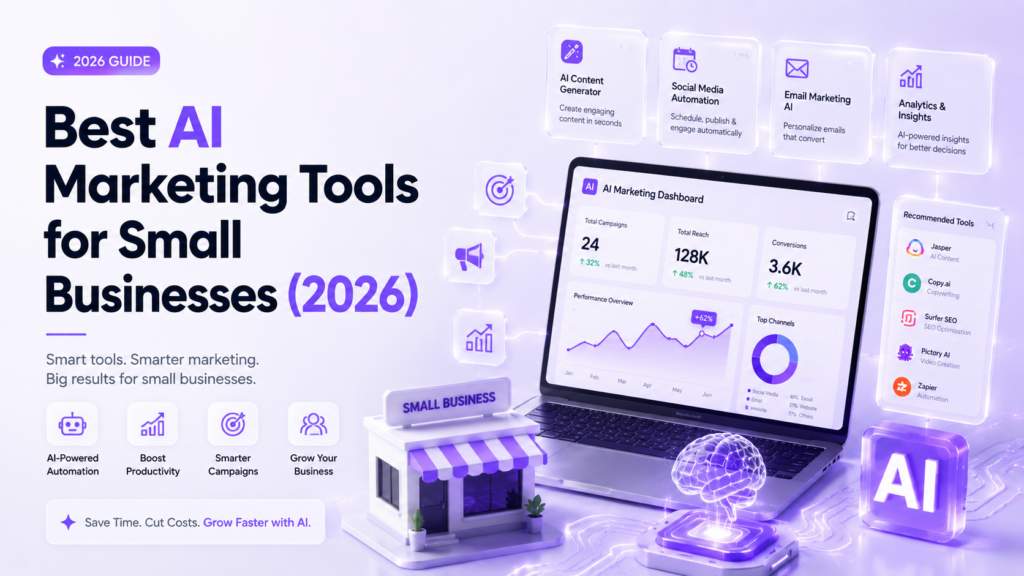
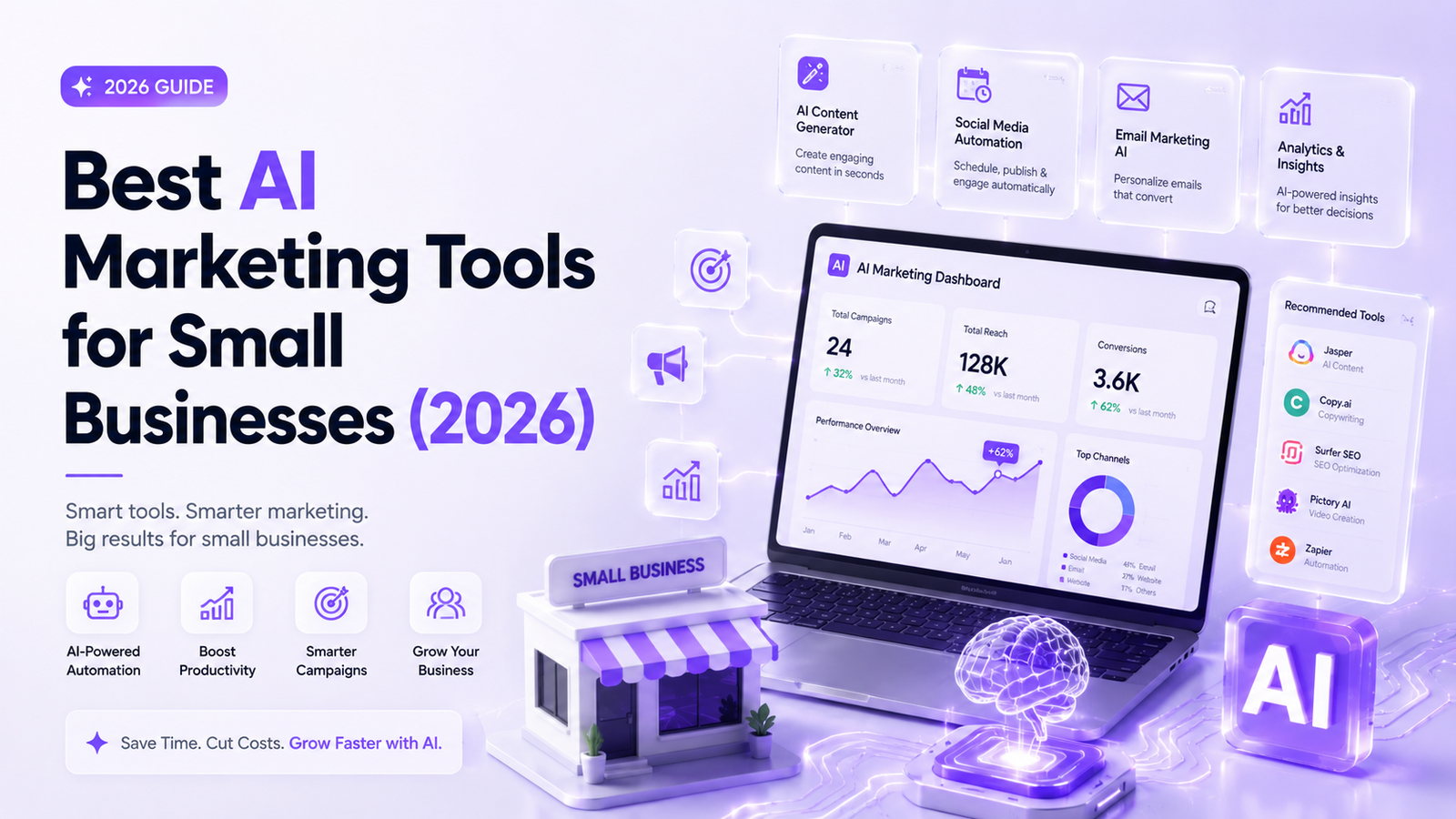
Below is your ultimate guide to the top AI tools that deliver real growth for small businesses in 2026.
Why Small Businesses Need AI Marketing Tools in 2026
For years, small business owners faced a steep trade-off: spend tens of thousands on external marketing agencies or spend 20 hours a week struggling with manual content creation. Modern AI tools for marketing bridge that gap permanently.
Here is why adopting AI tools is essential for staying competitive:
Leveling the Playing Field: Small teams can produce studio-quality videos, polished graphics, and optimized articles that rival large corporate brands.
Drastic Time Savings: AI reduces tasks that used to take hours—such as drafting social media captions or building email sequences—to just seconds.
Hyper-Personalization: Marketing automation AI enables personalized messaging based on individual customer browsing behavior, raising conversion rates significantly.
Smarter Budget Allocation: Machine learning algorithms continuously adjust ad spending toward high-performing audiences, minimizing wasted ad dollars.
The 10 Best AI Marketing Tools for Small Businesses
1. ChatGPT (OpenAI) – Best Overall AI Marketing Assistant
ChatGPT remains the foundational Swiss Army knife for small business owners. Powered by GPT-4o, it can synthesize market research, outline full content strategies, write initial copy drafts, and even analyze customer feedback files.
Key Features: Web browsing capability, custom GPT building, voice mode, image generation via DALL-E, and raw data analysis.
Pros: Highly versatile, extremely affordable, intuitive conversational interface.
Cons: Requires clear prompting to produce nuanced, non-generic copy.
Pricing: Free plan available; Plus plan starts at $20/month.
2. Jasper AI – Best for Brand Voice & Ad Copywriting
While general chatbots are helpful, Jasper AI is specifically engineered for commercial copywriters and growth marketers. Its killer capability is learning your company’s unique style guide, ensuring every generated email, blog post, or ad matches your tone.
Key Features: Style guide memory, multi-channel campaign builders, SEO integrations, and pre-built marketing templates.
Pros: Maintains exact voice across your entire team; stellar ad copy output.
Cons: Higher starting price than basic chatbot tools.
Pricing: Starts around $39/month per seat.
3. Canva Magic Studio – Best for Visual & Graphic Design
Visual content is non-negotiable on social media, but hiring a full-time designer isn’t always in the budget. Canva’s Magic Studio brings generative graphics, visual background removers, and auto-resizing templates into a simple drag-and-drop workflow.
Key Features: Magic Design for instant layouts, Magic Write captioning, background eraser, and one-click translation.
Pros: Incredibly beginner-friendly, thousands of royalty-free assets included.
Cons: Popular templates can feel recognizable if not customized.
Pricing: Free tier available; Pro tier starts at $14.99/month.
4. Surfer SEO – Best for SEO Content Creation
Writing content is only half the battle; ensuring Google actually ranks it is what drives sales. Surfer SEO analyzes top-ranking Google results in real time and gives you precise keyword targets, optimal word count ranges, and structural recommendations as you write.
Key Features: Live Content Editor score, keyword research modules, internal linking audits, and AI outline builders.
Pros: Takes the guesswork out of organic Google ranking.
Cons: Can encourage over-optimization if recommendations are followed blindly.
Pricing: Essential plan starts at $89/month.
5. HubSpot Breeze AI – Best for All-in-One CRM & Email Automation
HubSpot’s Breeze AI integrates artificial intelligence directly into customer relationship management (CRM). It helps small sales and marketing teams write personalized email sequences, summarize deal pipelines, and deploy conversational site bots.
Key Features: Smart email copy assistant, predictive lead scoring, autonomous support bots, and contact enrichment.
Pros: Eliminates data silos by combining CRM and marketing engine in one hub.
Cons: Enterprise features become expensive quickly as contact lists expand.
Pricing: Free basic CRM; paid marketing starter bundles start around $15–$20/month.
6. Predis.ai – Best for Social Media Reels & Posts
Creating content across Instagram, TikTok, LinkedIn, and Facebook can consume hours every week. Predis.ai allows you to input a simple product URL or single prompt to instantly generate complete social posts, carousels, short-form video reels, and tailored captions.
Key Features: Auto-generated visual reels with voiceovers, competitor analysis, hashtag suggestions, and multi-platform scheduler.
Pros: Solves social media blank-page syndrome completely.
Cons: Requires quick human review to polish voiceover cadences.
Pricing: Free plan available; Solo plan starts at $32/month.
.
7. AdCreative.ai – Best for Performance Ad Creatives
Running Meta or Google Ads without high-converting graphics burns budgets quickly. AdCreative.ai uses machine learning trained on millions of high-performing ads to generate graphics, banners, and headline variations designed specifically to maximize click-through rates (CTR).
Key Features: Predictive CTR scoring, instant banner generation in 100+ ratios, competitor ad insights, and direct Meta/Google integrations.
Pros: Drastically cuts ad graphic production costs and increases conversion rates.
Cons: Visual styles can feel slightly repetitive without custom photography uploads.
Pricing: Plans start at $29/month.
8. HeyGen – Best for AI Video Creation & Avatars
Video converts better than static text, but filming requires cameras, lighting, and comfortable spokespersons. HeyGen turns text scripts into photorealistic AI avatar videos in over 40 languages. It is ideal for product walkthroughs, customer onboarding, and social video ads.
Key Features: Custom avatar cloning, realistic voice synthesis, automated script-to-video builder, and instant translation.
Pros: Studio-quality video production without ever stepping in front of a lens.
Cons: Custom digital twin creation requires an initial recording setup.
Pricing: Starter plan begins at $24/month.
9. Clay – Best for Lead Enrichment & Sales Outreach
For B2B small businesses, Clay transforms outbound sales. It aggregates over 50 data providers (like LinkedIn, Apollo, and Clearbit) and uses AI agents to research prospects, find verified email addresses, and draft personalized outreach messages.
Key Features: Waterfall data enrichment, AI research web scrapers, dynamic cold email personalizers, and CRM syncing.
Pros: Replaces an entire team of sales research reps.
Cons: Has a steeper learning curve than simple email blast tools.
Pricing: Starter plan begins around $149/month.
10. Zapier / n8n – Best for No-Code Workflow Automation
The real magic happens when your tools talk to each other without human intervention. Zapier and its open-source counterpart n8n allow you to trigger AI tasks between your tools—for example, automatically summarizing a new lead’s form response, generating an AI follow-up draft, and pushing it to Slack.
Key Features: Thousands of app integrations, conditional logic branching, and native AI action steps.
Pros: Saves dozens of hours spent on manual data transfer every week.
Cons: Multi-step zaps require careful setup and testing.
Pricing: Free tiers available; paid plans start around $20/month.
Key Categories of AI Marketing Software
When building your marketing technology stack, focus on tools that solve your immediate bottleneck:
                  ┌───────────────────────────────────────────┐
                  │    Core AI Marketing Stack Breakdown      │
                  └─────────────────────┬─────────────────────┘
                                        │
      ┌─────────────────┬───────────────┴───────────────┬─────────────────┐
      │                 │                               │                 │
┌─────▼──────┐   ┌──────▼───────┐               ┌───────▼──────┐   ┌──────▼──────┐
│  Content   │   │ Social Media │               │ Automation   │   │ Analytics & │
│ Creation   │   │  & Visuals   │               │   & CRMs     │   │ Paid Ads    │
├────────────┤   ├──────────────┤               ├──────────────┤   ├─────────────┤
│ • ChatGPT  │   │ • Canva      │               │ • HubSpot    │   │ • AdCreative│
│ • Jasper   │   │ • Predis.ai  │               │ • Clay       │   │ • Surfer SEO│
│ • HeyGen   │   │ • Copy.ai    │               │ • Zapier     │   │ • Google/Meta│
└────────────┘   └──────────────┘               └──────────────┘   └─────────────┘
AI Content Creation Tools: Focus on copywriting, long-form blogging, and video script generation.
AI Social Media Tools: Automate content calendar generation, image creation, auto-captioning, and short-form video editing.
Marketing Automation AI & CRMs: Manage customer lists, trigger personalized email journeys, and qualify leads.
AI Analytics Platforms & Paid Ads: Optimize ad spend, track search rankings, and report on channel ROI automatically
How to Choose the Right AI Stack for Your Business
Buying every tool on this list will quickly drain your budget without adding proportional value. Follow this 4-step checklist to build a focused, cost-effective workflow:
Step 1: Identify Your Biggest Time Drain
Determine where your team wastes the most hours. If you struggle with blog writing, prioritize an AI content creation tool like Jasper or ChatGPT. If graphic design is your roadblock, start with Canva Magic Studio.
Step 2: Ensure Integrations Fit Your Existing Tools
Check if the tool connects smoothly with your existing website platform (WordPress, Shopify, Squarespace) and email providers.
Step 3: Test Free Trials Before Committing
Most platforms offer 7-day trials or freemium tiers. Test them on real projects to verify output quality.
Step 4: Audit Tool ROI Monthly
If an AI software application isn’t saving your team at least 5 hours per month or generating measurable leads, cancel it and reallocate the budget
Mini Case Study: How a Local Retailer Scaled Sales by 140%
The Business: A boutique home decor shop with one brick-and-mortar storefront and an online Shopify website.
The Problem: The owner spent over 15 hours every week writing product descriptions, designing Instagram graphics, and manually sending email newsletters—leaving little time for product sourcing.
The Solution:
Used ChatGPT to turn raw supplier feature sheets into high-converting product descriptions in seconds.
Adopted Canva Magic Studio to auto-generate promotional social assets from product photos.
Set up Predis.ai to schedule automated Instagram Reels and post carousels.
The Results (60 Days Later):
Time Saved: Marketing creation time dropped from 15 hours to 3 hours per week.
Social Engagement: Instagram reach increased by 210%.
Revenue Growth: Online store sales jumped 140%, directly driven by consistent social campaigns and updated product pages.
Expert Tips for Maximizing AI Marketing Tools
Treat AI as a Junior Assistant, Not a Senior Director: Always review, edit, and fact-check generated copy before hitting publish.
Build a Centralized Prompt & Brand Guide: Store your brand voice, persona descriptions, and top-performing prompt templates in a central document for your team.
Combine Tools for Compound Efficiency: Use ChatGPT for article ideas, Surfer SEO for content outline structure, Canva for post thumbnails, and Zapier to schedule distribution.
Prioritize Human Connection: Use AI to handle tedious formatting and drafting, freeing up your energy to build genuine, personal relationships with customers.
Common Mistakes to Avoid When Using AI in Marketing
Publishing Unedited Raw Outputs: Standard AI copy can sound robotic or generic. Infuse personal stories, real customer quotes, and specific industry experience.
Tool Overload (Subscription Bloat): Buying 10 different single-use AI tools leads to confusion and wasted money. Master 2 or 3 core platforms first.
Ignoring SEO Intent: AI can generate text rapidly, but if it doesn’t solve the specific search intent of your audience, it won’t rank on Google.
Neglecting Analytics: Don’t assume AI-generated ads will automatically convert. Test creative variations continuously using AI analytics platforms
Conclusion
Choosing the best AI marketing tools for your small business isn’t about adopting every shiny new app on the market. It is about identifying your biggest operational bottlenecks and using targeted AI marketing software to eliminate them.
By combining tools like ChatGPT for content strategy, Canva for visual assets, Surfer for SEO optimization, and HubSpot for customer automation, a small team can produce agency-level campaigns with minimal stress. The key is to start small, keep human creativity at the center of your brand, and systematically test what drives real revenue.
Internal SEO & Authority References
5 Internal Linking Opportunities
Anchor: “step-by-step local SEO guide” -> Link to internal article on local search engine optimization strategies.
Anchor: “high-converting landing page strategies” -> Link to internal guide on web design conversion rate optimization (CRO).
Anchor: “social media content calendar template” -> Link to downloadable internal resource or template post.
Anchor: “small business email marketing guide” -> Link to internal post on building newsletter lists.
Anchor: “measuring customer acquisition cost (CAC)” -> Link to internal article on small business financial metrics.
5 External Authority Sources
Google Search Central (Official documentation on AI-generated content guidelines and search quality standards)
Salesforce State of Marketing Report (Industry benchmarking statistics on AI adoption rates in small enterprise marketing)
HubSpot Research Insights (E-commerce and SMB inbound growth trends)
Harvard Business Review (Strategic analysis on generative AI integration in small business operations)
Small Business Administration (SBA.gov) (Resources and digital transformation guides for independent business owners)