
For a small business, having a website is only the first step toward building an online presence. The bigger challenge is making sure potential customers can actually find that website when they search for products, services, or answers online. This is where search engine optimization (SEO) becomes important.
A well-planned SEO strategy can help a small business improve its visibility, attract relevant visitors, and build a stronger online presence without depending entirely on paid advertising. However, SEO works best when it focuses on useful content, a good website experience, and the needs of the target audience.
Here are practical steps small businesses can follow to build an effective SEO strategy in 2026.
1. Understand Your Target Audience
Before choosing keywords or creating content, understand who you want to reach. Identify your ideal customers, their common questions, the problems they want to solve, and the words they are likely to use when searching online.
For example, a local bakery should not create content only around the general term “bakery.” It may also target searches related to birthday cakes, custom cakes, wedding cakes, or bakeries in its local area.
Understanding search intent helps businesses create pages that answer what people are actually looking for.
2. Conduct Keyword Research
Keyword research is a fundamental part of an SEO strategy. It helps you discover the phrases potential customers use in search engines.
Small businesses should focus on relevant keywords that match their products, services, and audience. Long-tail keywords can also be useful because they are usually more specific and can reflect a clearer search intent.
Instead of repeatedly using one broad keyword, create content around related questions and topics. The goal should be to use keywords naturally rather than forcing them into every paragraph.
3. Optimize Your Website for On-Page SEO
On-page SEO helps search engines and users understand what each page is about. Start with clear page titles, useful headings, descriptive URLs, and relevant meta descriptions.
Use H1, H2, and H3 headings to organize longer content into easy-to-read sections. Add internal links where they genuinely help readers discover related pages.
Images should also have descriptive file names and useful alt text. These small improvements can make a website easier to understand and navigate.
4. Create Helpful, High-Quality Content
Content should be created for people first, not simply to include keywords. A small business can publish blog posts, tutorials, guides, FAQs, case studies, and other resources that answer customers’ questions.
For example, a digital marketing agency could publish guides about SEO basics, content marketing, keyword research, or common website mistakes.
Avoid creating articles that repeat the same information without adding anything useful. Strong content should be clear, accurate, easy to understand, and focused on a specific purpose.
It is also useful to review older content regularly. Updating outdated information can help keep valuable pages relevant to readers.
5. Focus on Local SEO
For businesses that serve a specific city or area, local SEO can be especially valuable. Make sure your business information is accurate and consistent across important online listings.
A properly maintained Google Business Profile can help customers discover a local business through search and maps. Businesses should also provide accurate contact information, opening hours, services, and location details.
Customer reviews can provide additional trust for people considering a local business. Encourage genuine customers to share honest feedback rather than using artificial or misleading reviews.
6. Build Relevant, Quality Backlinks
Backlinks are links from other websites to your website. When they come from relevant and trustworthy sources, they can support a website’s authority and visibility.
Small businesses can earn backlinks by creating useful resources, contributing valuable guest articles, participating in relevant industry discussions, or producing original information that other websites want to reference.
Quality matters more than quantity. Businesses should avoid spammy link-building practices and irrelevant links that provide no value to readers.
7. Improve Website Speed and Mobile Experience
A website should be easy to use on both computers and mobile devices. Since many people browse the internet using smartphones, a poor mobile experience can make it harder for visitors to stay on a website.
Check whether pages load efficiently, navigation is simple, text is readable, and important buttons or links are easy to use.
A fast and user-friendly website can create a better experience for visitors while supporting broader SEO efforts.
8. Track SEO Performance
SEO should not be treated as a one-time task. Small businesses should regularly review how their website is performing.
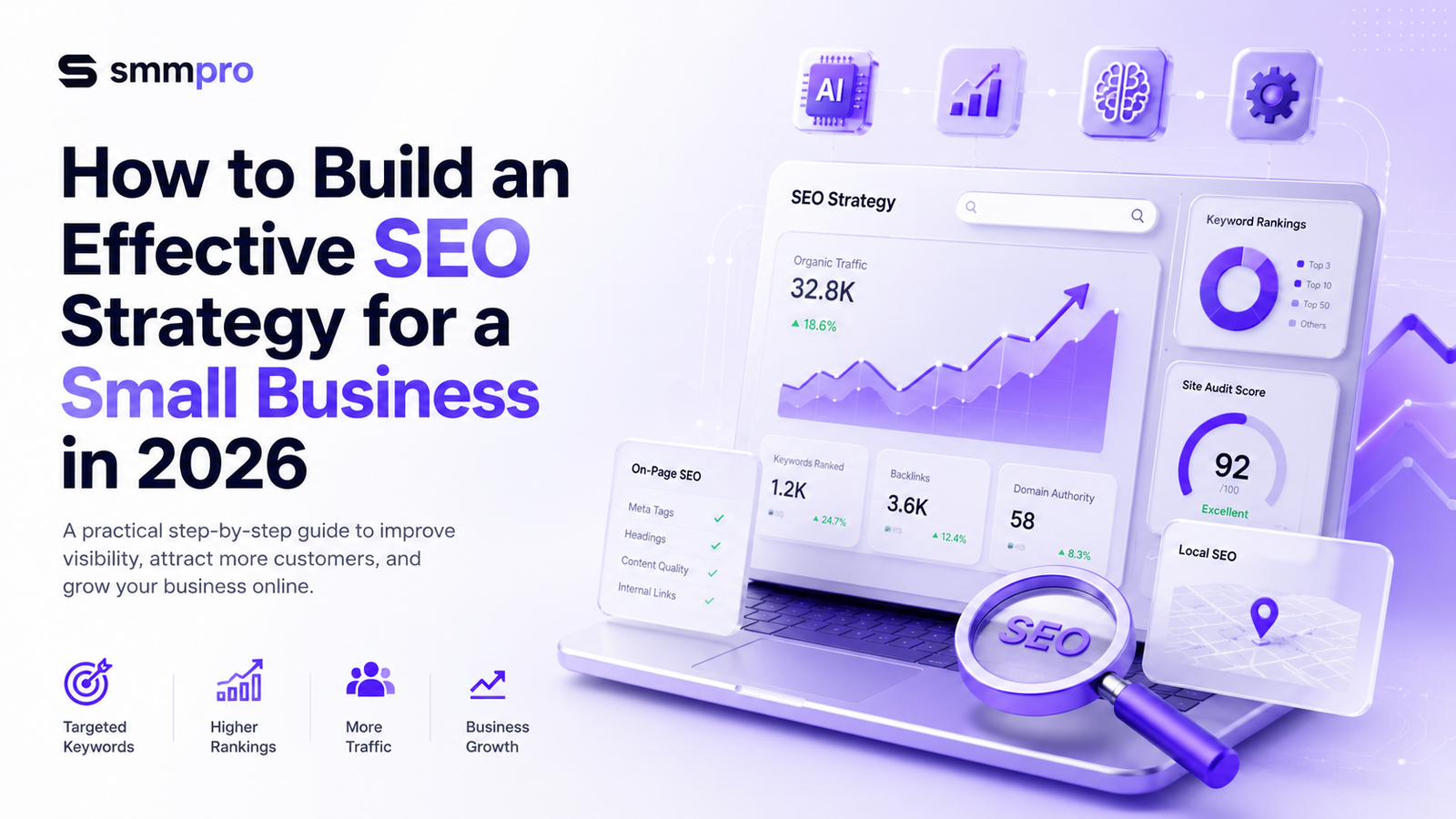
Important measurements can include organic traffic, search impressions, clicks, keyword performance, engagement, and conversions. Tools such as Google Search Console and Google Analytics can help businesses understand how visitors find and interact with their websites.
If a page receives impressions but very few clicks, its title or description may need improvement. If visitors arrive but do not take meaningful actions, the page content or user experience may need attention.
9. Avoid Common SEO Mistakes
Some common mistakes can weaken an SEO strategy. These include keyword stuffing, publishing copied content, using irrelevant backlinks, ignoring mobile users, and expecting immediate results.
SEO generally requires consistency. Instead of trying to manipulate search engines with shortcuts, businesses should focus on creating useful content and improving the overall website experience.
Conclusion
Building an effective SEO strategy does not require a small business to do everything at once. Start by understanding the target audience, researching relevant keywords, improving important website pages, and creating genuinely helpful content.
Local SEO, quality backlinks, mobile optimization, and performance tracking can then strengthen the strategy over time.
The most important principle is to focus on providing value. When a small business consistently creates useful content and offers a good website experience, SEO can become a sustainable way to improve online visibility and connect with potential customers in 2026.
FAQ
FAQs about How to Build an Effective SEO Strategy for a Small Business in 2026
An effective SEO strategy for a small business combines audience research, keyword targeting, useful content, on-page optimization, local SEO, technical improvements, and performance tracking. The goal is to make the website easier for search engines to understand and more useful for potential customers. Businesses should prioritize relevant search intent and long-term value rather than trying to manipulate rankings.
Start by identifying your target audience and the searches they use, then research relevant keywords and organize them around your products, services, and customer questions. Next, optimize important pages, create helpful content, improve mobile usability and site performance, build relevant backlinks, and track results through tools such as Google Search Console and Google Analytics.
Choose keywords that closely match your products, services, audience, and search intent. Focus on specific phrases that describe what customers actually need, including long-tail searches such as service-based or location-based queries. Avoid targeting broad keywords simply because they have high visibility; relevance and the ability to satisfy the searcher’s need are more important.
Local SEO helps a business become more visible when people search for products or services in a specific geographic area. It includes maintaining accurate business information, optimizing a Google Business Profile, providing location and service details, and earning genuine customer reviews. It is especially valuable for businesses that serve customers in a particular city, town, or region.
Create clear, accurate, people-first content that directly answers real customer questions and demonstrates useful subject knowledge. Organize information with descriptive headings, specific explanations, examples, and relevant internal links. Content should satisfy the underlying search intent rather than simply repeating keywords, making it easier for both users and answer systems to understand the topic.
No. Relevant, trustworthy backlinks are generally more valuable than a large number of unrelated or low-quality links. Small businesses can earn useful links by publishing original resources, contributing genuinely valuable industry content, and creating information that other websites have a reason to reference. Avoid spammy link-building tactics that provide little value to users.
Improve mobile SEO by making pages load efficiently, keeping navigation simple, using readable text, and ensuring important buttons and links are easy to use on smaller screens. Review page performance and usability regularly because visitors should be able to find information and complete important actions without unnecessary friction on smartphones and tablets.
Measure SEO performance using organic traffic, search impressions, clicks, keyword visibility, engagement, and conversions. Google Search Console can show how people discover your pages through search, while Google Analytics can help analyze what visitors do after arriving. Look for patterns rather than relying on one metric—for example, high impressions with low clicks may indicate that a page’s search result presentation needs improvement.
Common mistakes include keyword stuffing, copied or unhelpful content, irrelevant backlinks, poor mobile usability, and expecting immediate results. Another mistake is treating SEO as a one-time task instead of an ongoing process. Small businesses should focus on useful content, clear website structure, relevant optimization, and continuous performance monitoring rather than shortcuts designed to manipulate search visibility.
SEO can be worthwhile for a small business when it consistently targets relevant searches and provides useful experiences for potential customers. It can support long-term visibility without requiring every visitor to come through paid advertising. The value depends on factors such as competition, search demand, website quality, content relevance, local presence, and how effectively organic visitors are converted into customers.