
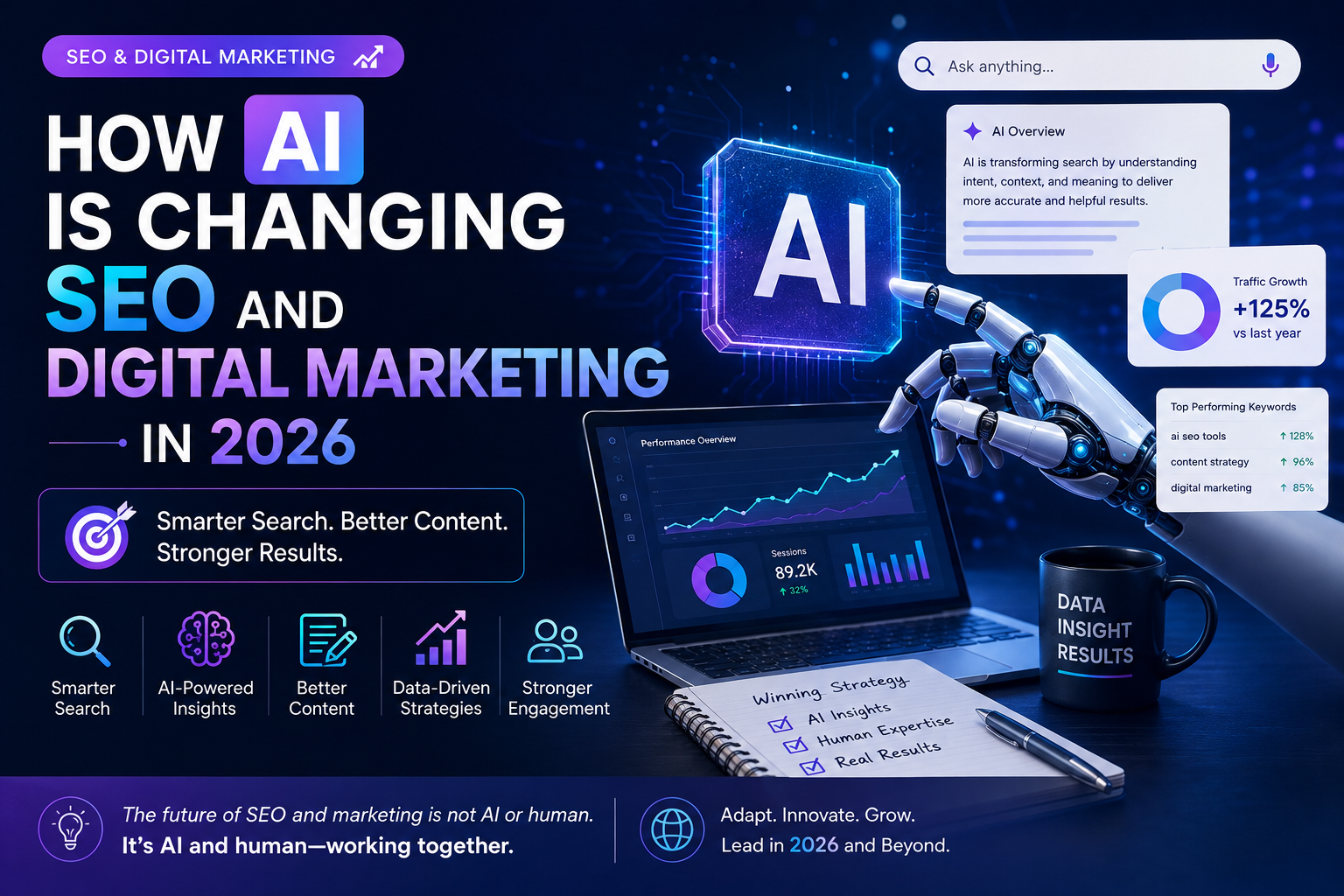
Artificial intelligence is changing the way businesses approach SEO and digital marketing in 2026. Search engines are becoming better at understanding meaning, intent, context, and user behavior, while AI tools are helping marketers research topics, create content, analyze data, and improve campaigns. The biggest opportunity is not to replace marketers with AI, but to use AI to make better decisions and produce more useful experiences for customers.
Businesses that treat AI as a shortcut for publishing large amounts of generic content may struggle to build trust. On the other hand, marketers who combine AI efficiency with human expertise, original insights, and careful editing can create content that is more useful and competitive.
1. AI Is Changing How People Search
Search is becoming more conversational. Users increasingly ask complete questions instead of typing short keywords, and AI-powered search experiences can provide direct summaries, comparisons, and recommendations.
This means marketers need to think beyond individual keywords. Content should answer the underlying question clearly, cover related subtopics, and provide enough context for both users and search systems to understand the subject. A page that solves the user’s problem is more valuable than a page written simply to repeat a target phrase.
2. Search Intent Matters More Than Keyword Repetition
Modern SEO is increasingly focused on search intent. Before creating an article, marketers should determine what the user actually wants: information, a comparison, a product, a service, or a specific solution.
AI can help organize keyword research and identify patterns, but the final strategy should come from human judgment. A useful process is to group related queries by intent, identify the questions users commonly ask, and then create content that provides a complete answer. This produces a stronger experience than forcing the same keyword into every paragraph.
3. AI Makes Content Research Faster
AI can speed up the research stage of content marketing. It can help marketers generate topic ideas, organize questions, summarize large amounts of information, and identify areas that deserve further investigation.
However, AI-generated research should not automatically be treated as fact. Marketers should verify important claims against reliable sources and add original examples, data, experience, or expert commentary. The goal is to use AI to accelerate research rather than remove the research process.
4. Human Expertise Is Still Essential
AI can produce fluent text, but useful marketing content needs more than fluent sentences. Readers want practical advice, accurate information, real examples, and a clear point of view.
Human expertise is especially important for demonstrating experience. A marketer can improve an AI-assisted draft by adding lessons from real campaigns, original observations, customer questions, case studies, screenshots, and specific recommendations. These details make content more distinctive and useful.
5. Technical SEO and Website Performance Still Matter
AI does not remove the fundamentals of technical SEO. Websites still need to be crawlable, accessible, fast, mobile-friendly, and logically organized.
Marketers should pay attention to page performance, internal linking, descriptive titles, useful headings, structured content, broken links, and other technical issues. A strong article cannot perform well if users have difficulty accessing or navigating the website. AI tools can help identify technical opportunities, but marketers should review recommendations before implementing changes.
6. AI Can Improve Content Strategy
AI can help marketers build a more organized content strategy. Instead of choosing topics randomly, teams can use AI to group related questions and identify content gaps.
For example, a business could create a main guide about digital marketing and then develop supporting articles covering SEO, social media, email marketing, analytics, content creation, and conversion optimization. Internal links can connect these resources and help users move naturally from broad information to more specific solutions.
The important point is that AI should support the strategy, not become the strategy. The business still needs to understand its audience, products, competitors, and goals.
7. Personalization Is Becoming More Practical
Digital marketing can use AI to analyze customer behavior and identify patterns. This can support more relevant recommendations, email campaigns, audience segments, and advertising messages.
Personalization should be useful rather than intrusive. Customers are more likely to respond positively when a message helps them solve a problem or discover something relevant. Businesses should also handle customer data responsibly and follow applicable privacy requirements.
8. AI Can Improve Social Media Marketing
Social media teams can use AI for brainstorming content ideas, creating draft captions, organizing publishing calendars, analyzing engagement patterns, and adapting content for different platforms.
Human review remains important because social content needs personality and context. Automated posts can sound repetitive or disconnected from current events. The strongest workflow is often AI-assisted planning followed by human editing, brand review, and community interaction.
9. Measurement Is Becoming More Important
As AI changes search and advertising, marketers need to focus on meaningful business outcomes rather than vanity metrics alone. Traffic is useful, but conversions, qualified leads, revenue, engagement quality, and customer retention often provide a clearer picture of performance.
AI can help analyze large datasets and identify trends, but marketers should define the right metrics first. A sophisticated dashboard cannot fix a poorly chosen objective.
10. Common AI Marketing Mistakes to Avoid
One common mistake is publishing unedited AI-generated content. Another is relying on unsupported claims, copying competitors, producing repetitive articles, or using AI only to insert keywords.
Businesses should also avoid creating content without a clear audience or purpose. Every article should answer a real question or support a real customer need. Before publishing, marketers should fact-check important statements, improve the writing, add original value, review links, and make sure the content reflects the brand’s expertise.
A Practical AI SEO Workflow for 2026
A practical workflow can be simple. First, define the audience and business goal. Second, research the topic and search intent. Third, use AI to brainstorm questions, outlines, and supporting ideas. Fourth, verify information using reliable sources. Fifth, write or edit the content with original insights and examples. Sixth, optimize the page for users and search engines. Finally, publish, measure results, and improve the content over time.
This workflow keeps humans responsible for quality while allowing AI to handle repetitive tasks more efficiently.
Conclusion
AI is changing SEO and digital marketing in 2026, but the fundamentals of good marketing remain the same: understand the audience, provide genuine value, communicate clearly, and measure results.
The most successful marketers are likely to be those who combine AI’s speed with human judgment. AI can help discover ideas, organize information, analyze data, and accelerate production. People are still needed to provide expertise, creativity, context, originality, and trust.
Instead of asking whether AI will replace digital marketers, businesses should ask how their teams can use AI responsibly to create better content and better customer experiences. That shift can turn AI from a simple productivity tool into a practical part of a long-term digital marketing strategy.