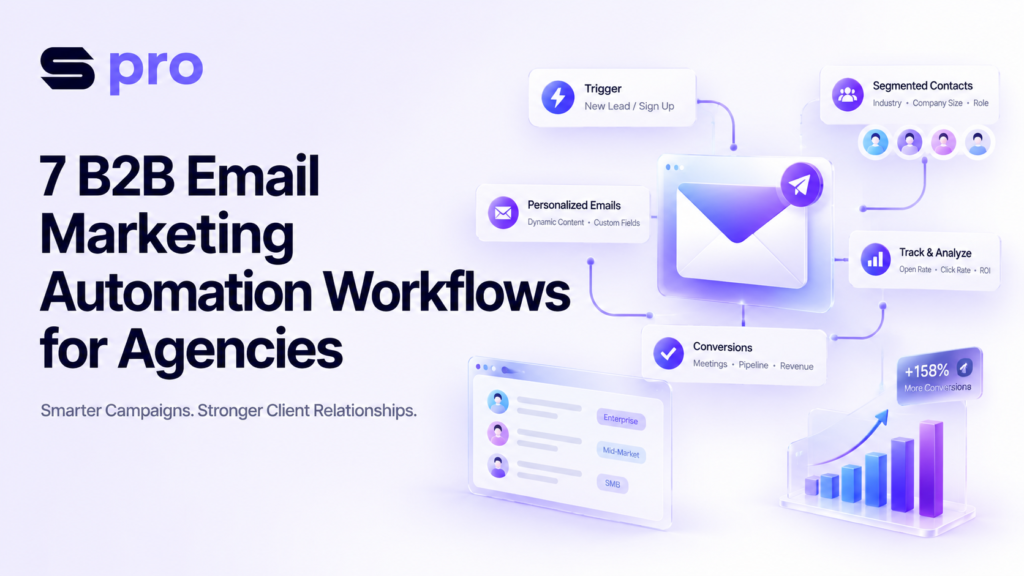

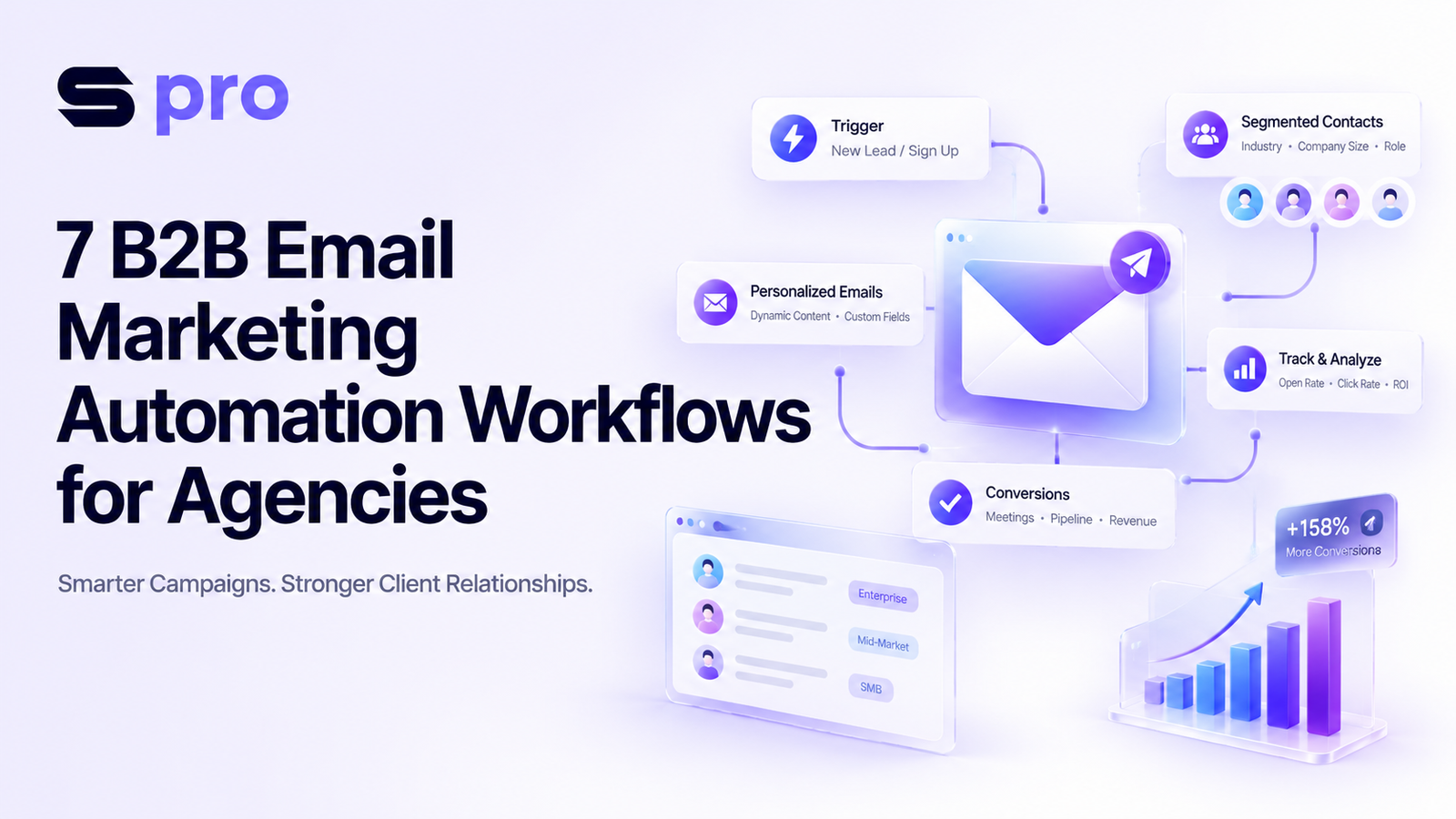
Running a digital marketing or creative agency means juggling client acquisition, campaign execution, and internal operations all at once. If your team is still manually sending follow-up emails, onboarding packets, or check-in reminders, you are burning valuable hours that could be spent on scaling. This is where strategic B2B email marketing automation workflows change the game.
In today’s competitive agency landscape, growth isn’t just about landing more clients; it’s about building repeatable, scalable systems that nurture prospects and retain accounts effortlessly. Implementing robust email automation for digital agencies allows you to deliver personalized communication at scale without increasing headcount. Whether you are looking to refine your lead nurturing email sequence or automate your onboarding pipeline, smart workflows keep your agency top-of-mind. Let’s dive into the 7 essential workflows every growth-focused agency needs.
1. The Cold Outreach & Prospecting Welcome Workflow
When you target high-value B2B decision-makers, cold email remains a primary engine for pipeline growth. However, a single cold email rarely closes a deal. You need an automated sequence that builds trust, addresses pain points, and establishes authority over several days.
How It Works
Trigger: A prospect replies positively to a cold email or downloads a gated lead magnet from your agency website.
Delay 1 (Instant): Send a thank-you note with the requested asset or a brief case study relevant to their industry.
Delay 2 (2 Days): Share a short Loom video or a breakdown of how you solved a similar problem for an industry peer.
Delay 3 (4 Days): Send a soft CTA inviting them to a brief 15-minute discovery audit.
Expert Tip: Keep your initial emails conversational and text-based. Avoid heavy HTML templates in cold outreach phases, as they often trigger spam filters and feel corporate.
2. The High-Value Lead Nurturing Sequence
Not every prospect is ready to buy on day one. Some leads need weeks or months of education before they trust an agency with their marketing budget. A structured lead nurturing email sequence keeps your brand warm while establishing deep expertise.
Key Components of a Nurturing Sequence
Educational Content: Share deep dives into SEO trends, PPC optimization strategies, or social media algorithm shifts.
Social Proof: Highlight client success stories, ROI metrics, and video testimonials.
Low-Friction Offers: Invite subscribers to free webinars, masterclasses, or proprietary marketing calculators.
+-------------------------------------------------------------+
|              High-Value Nurturing Workflow                   |
+-------------------------------------------------------------+
| Day 1: Educational Framework / Industry Guide               |
| Day 3: Case Study: How We Scaled Client X by 200%           |
| Day 6: FAQ: Overcoming Common In-House Marketing Hurdles    |
| Day 10: Invitation to Free Strategy Audit                   |
+-------------------------------------------------------------+
3. Automated Lead Onboarding & Discovery Call Workflow
Booking a discovery call is only half the battle. In B2B sales, prospect ghosting and no-shows can severely disrupt an agency’s sales pipeline. An automated lead onboarding email sequence ensures prospects arrive prepared, excited, and informed.
Step-by-Step Flow
Instant Confirmation: Sent immediately after calendar booking, confirming the time and linking the meeting room.
Pre-Call Homework (24 Hours Before): Send a brief questionnaire about their current marketing setup, historical ad spend, and primary bottlenecks.
SMS / Email Reminder (1 Hour Before): A quick nudge to minimize no-show rates.
4. The Proposal Follow-Up & Objection Handling Workflow
You’ve delivered the custom proposal, but days pass with silence. Instead of manually tracking every proposal date, an automated sequence steps in to gently nudge decision-makers while preemptively answering common price or scope objections.
Handling Common Objections
Timing: “Is Q3 too busy for a new marketing push? Here is how we launch campaigns in under 14 days.”
Budget: “Worried about ROI? Read our breakdown of how agency retainers generate positive cash flow within 90 days.”
Trust: “See why SaaS and e-commerce leaders trust our specialized frameworks.”
5. Client Onboarding & Project Kickoff Workflow
| Stage\ | Action Item\ | Automation Trigger\ |
|---|---|---|
| \Welcome\\ | Send welcome packet & Slack channel invite\ | Contract signature\ |
| \Data Collection\\ | Request brand assets, logins, & brand guidelines\ | 24 hours post-signature\ |
| \Kickoff Prep\\ | Reminder for kickoff meeting & agenda overview\ | 48 hours before kickoff call\ |
| \First Week Check-in\\ | Automated survey on onboarding experience\ | 7 days post-kickoff\ |
6. The Client Retention & Quarterly Review Workflow
Retaining existing clients is five times cheaper than acquiring new ones. Agencies that rely solely on monthly reporting often lose clients when communication lapses. Proactive check-ins and quarterly strategic reviews dramatically boost long-term lifetime value (LTV).
Milestone Emails: Celebrate 6-month and 1-year anniversaries with a custom performance summary.
QBR Reminders: Automatically prompt account managers to schedule quarterly business reviews 3 weeks before the quarter ends.
Upsell Triggers: Introduce advanced services (like marketing automation or video production) after a client hits specific milestone KPIs.
7. The Win-Back & Re-Engagement Workflow
Prospects who went dark or former clients who paused their retainers represent low-hanging fruit. A targeted win-back campaign re-engages cold contacts with minimal ad spend.
Crafting a Win-Back Sequence
The “Checking In” Email: A friendly note asking what their current primary marketing focus is.
The “What’s New” Update: Share new agency capabilities, case studies, or proprietary tech stacks launched since you last spoke.
The Breakup Email: Politely close the loop if there is no response, which often triggers an immediate reply due to loss aversion.
Best Practices for Agency Email Automation
To ensure your email marketing automation strategy delivers high ROI, keep these core principles in mind:
Segment Your Audience: Never send the same generic blast to cold prospects, active leads, and enterprise clients.
Keep Personalization Deep: Use dynamic fields for company name, industry vertical, and specific pain points.
Optimize for Mobile: Over 60% of B2B executives read emails on mobile devices. Keep paragraphs short and buttons large.
Monitor Deliverability: Regularly clean your email list and maintain proper SPF, DKIM, and DMARC records.
Conclusion
Implementing these 7 B2B email marketing automation workflows allows your agency to scale client acquisition, nurture valuable prospects, and drive retention effortlessly. Start by auditing your current pipeline to identify where leads drop off the most, and build your first automated workflow there this week.
FAQ
FAQs about 7 Essential B2B Email Marketing Automation Workflows for Agency Growth
The seven essential B2B email marketing automation workflows for digital agencies are cold outreach welcome sequences, high-value lead nurturing, automated lead onboarding, proposal follow-up, client onboarding, client retention reviews, and win-back sequences. Together, these workflows automate the entire agency sales funnel—from cold prospect acquisition to long-term client retention.
A B2B lead nurturing email sequence keeps your agency top-of-mind with prospective clients who are not ready to buy immediately. By delivering targeted educational content, case studies, and framework breakdowns over several weeks, you build topical trust and position your team as an industry expert, significantly increasing sales pipeline conversion rates over time.
An automated lead onboarding email sequence should begin with an instant calendar booking confirmation, followed by a pre-call questionnaire 24 hours prior, and conclude with an email or SMS reminder one hour before the scheduled discovery call. This structure ensures prospects arrive fully prepared, pre-qualified, and educated about your services, which drastically reduces meeting no-shows.
The ideal cadence depends on the workflow type: cold outreach and lead onboarding perform best with 2 to 3 days between emails, whereas long-term B2B lead nurturing sequences typically space messages 5 to 7 days apart. Pacing your communications prevents email fatigue, protects domain deliverability, and gives busy B2B decision-makers adequate time to review your content.
Agencies should use plain text (or light text-based formatting) for cold outreach, lead discovery, and proposal follow-ups because it mimics organic peer-to-peer communication and yields higher deliverability rates. Branded HTML templates are better suited for newsletter broadcasts, formal welcome packets, or visual client onboarding guides after a lead becomes an active account.
Automated proposal follow-up sequences trigger structured reminders after a proposal is delivered, addressing common client objections regarding implementation timelines, budget ROI, or project scope without requiring manual tracking. Automating this phase keeps decision-makers engaged while maintaining sales momentum before leads go cold or turn to competing agencies.
Email automation improves client retention by systematically triggering project kickoff guides, milestone celebrations, satisfaction surveys, and quarterly business review (QBR) scheduling prompts. By keeping clients informed and regularly reminding account managers to conduct strategy check-ins, agencies actively combat client churn and unlock organic upsell opportunities.
The biggest mistake agencies make is over-automation—completely replacing human contact with rigid, generic email blasts. Automation should streamline administrative tasks, nurture leads, and handle routine triggers, but critical conversion points (such as discovery audits, proposal reviews, and account strategy sessions) must always incorporate personalized human communication.
Top-rated email automation and CRM platforms for digital marketing agencies include HubSpot, ActiveCampaign, Apollo.io, Klaviyo, and Brevo. The best choice depends on your specific focus: Apollo is ideal for outbound prospecting, ActiveCampaign and HubSpot excel at complex behavioral workflows and lead scoring, and Klaviyo is dominant for agencies specializing in e-commerce marketing.
Yes, small agencies and freelancers can build powerful B2B email marketing automation workflows using cost-effective tools like ActiveCampaign, MailerLite, or Brevo, which offer robust automation capabilities at low entry points. At SMMpro, we recommend starting with just two core workflows—lead onboarding and client kickoff—before expanding into complex multi-channel sequences.