Running a profitable digital marketing agency requires managing software overhead before it eats away at your margins. For years, the standard playbook was simple: sign up for an enterprise CRM, add team seats, and bill the client for your labor. Today, that model is straining agency economics. Per-seat licensing and tiered contact databases create an invisible “growth tax” that penalizes you as your client roster expands.
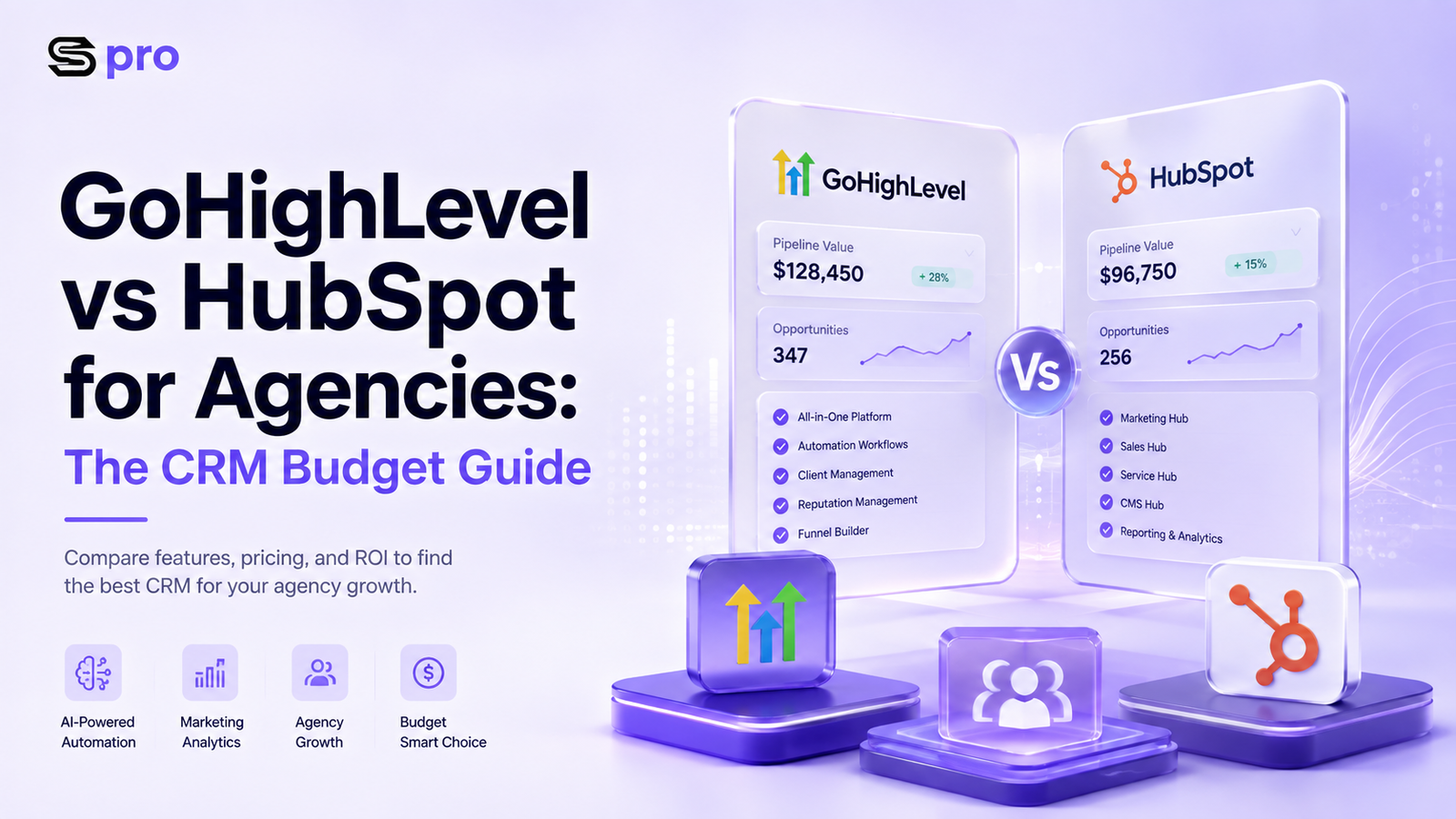
When choosing between GoHighLevel vs HubSpot for agencies, you are not just comparing two feature checklists. You are choosing between two fundamentally different business models:
A multi-tenant, flat-rate infrastructure designed for agencies to host unlimited client accounts under one subscription (GoHighLevel).
A single-tenant, modular enterprise platform built around inbound marketing, governance, and per-seat/per-contact pricing (HubSpot).
This guide breaks down the true total cost of ownership (TCO) across both platforms. We will model agency gross margins across 10, 25, and 50 client milestones, examine messaging unit economics, and help you select the right architecture for your agency’s growth goals.
The Core Architectural Difference: Multi-Tenant vs. Single-Instance
To understand why CRM budgets diverge so quickly, you must examine how each platform handles multiple client accounts.
+-------------------------------------------------------------------+
|                     AGENCY CRM ARCHITECTURE                       |
+-------------------------------------------------------------------+
|  GoHighLevel (Multi-Tenant)       |  HubSpot (Single-Tenant/Hubs)  |
|  - 1 Agency Master Account        |  - Separate Portal per Client |
|  - Unlimited Isolated Sub-Accounts|  - Per-Seat & Per-Contact Fees|
|  - Unified Snapshot Deployment    |  - Enterprise Partner Portal   |
|  - Flat Monthly Fee ($297/$497)   |  - Compounding Tier Costs     |
+-------------------------------------------------------------------+
GoHighLevel: Multi-Tenant Sub-Account Infrastructure
GoHighLevel was built from the ground up specifically for marketing agencies. Its core architecture consists of an Agency Master Account under which you can spawn isolated sub-accounts (also called client locations).
Sub-Account Isolation: Each client gets their own private sandbox with unique contacts, funnels, pipelines, calendars, and automation workflows.
Snapshot Deployment: Agencies can package entire marketing ecosystems—pre-built landing pages, email campaigns, SMS workflows, and pipeline stages—into a single “Snapshot” and deploy it to a new client account in seconds.
Centralized Team Access: Your internal agency team can jump between 50 client sub-accounts with a single login, without paying for additional user seats.
HubSpot: Enterprise Portals and Partner Architecture
HubSpot operates on a dedicated portal structure. Each business instance is an independent ecosystem designed around HubSpot’s modular “Hubs” (Marketing, Sales, Service, Operations, and Content).
Independent Portals: Clients typically maintain their own billing and HubSpot subscription. The agency gains administrative access through the HubSpot Partner Portal.
Data Depth and Governance: HubSpot provides superior enterprise-grade data hygiene, multi-touch revenue attribution, and deep customization of standard and custom CRM objects.
Per-Portal Licensing: If an agency wants to provide full automation to a client, that specific client portal must subscribe to a paid tier (such as Marketing Hub Professional), triggering dedicated base fees, seat costs, and onboarding requirements.
GoHighLevel Pricing vs HubSpot: The Financial Scaling Model
Pricing transparency is critical when calculating agency profitability. Below is a breakdown of how the two platforms price their tiers, followed by a direct financial comparison as your agency scales.
GoHighLevel Pricing Overview
Agency Starter ($97/month): Gives you up to 3 sub-accounts. Ideal for solo consultants managing 1–2 internal brands or pilot clients.
Agency Unlimited ($297/month): Unlocks unlimited sub-accounts, unlimited users, and complete white-label desktop branding. This is the baseline plan for growing agencies.
Agency Pro / SaaS Mode ($497/month): Adds automated SaaS rebilling (charging clients for software subscriptions with your custom markup), rebilling on telephony/SMS/email/AI credits, and advanced API access.
HubSpot Pricing Overview
Free Tools ($0): Basic contact management, simple forms, and limited email sending with HubSpot branding.
Starter Customer Platform ($15–$20/seat/month): Basic marketing emails and simple task automations. Lacks multi-branching workflow automations.
Marketing Hub Professional ($800–$890/month billed annually): Includes 3 core seats and 2,000 marketing contacts. Additional contacts cost approximately $225–$250/month per 5,000 contacts. Also carries a mandatory, one-time $3,000 onboarding fee.
Sales Hub Professional ($90–$100/seat/month): Unlocks custom sales pipelines, sequences, and advanced deal management.
Agency CRM Software Comparison: 10, 25, and 50 Client Milestones
The table below illustrates the software costs an agency incurs under two different operating models:
Agency-Hosted Model (GoHighLevel): The agency bundles the CRM as part of its retainer using gohighlevel sub accounts pricing on the Unlimited/Pro plan.
Client-Dedicated Model (HubSpot): The total software footprint required across client accounts using hubspot marketing hub professional cost alongside core seats.
| Metric / Scenario | 10 Managed Clients | 25 Managed Clients | 50 Managed Clients |
|---|---|---|---|
| GoHighLevel (Agency Unlimited / Pro) | $297 – $497 / mo | $297 – $497 / mo | $297 – $497 / mo |
| GHL Telephony / Usage (Estimated) | ~$150 / mo | ~$375 / mo | ~$750 / mo |
| Total Monthly Software Overhead (GHL) | $447 – $647 / mo | $672 – $872 / mo | $1,047 – $1,247 / mo |
| HubSpot (Marketing Hub Pro per Portal) | $8,000+ / mo | $20,000+ / mo | $40,000+ / mo |
| HubSpot Starter Alternative ($20/seat) | $400 – $600 / mo | $1,000 – $1,500 / mo | $2,000 – $3,000 / mo |
| Mandatory Onboarding Fees (HubSpot Pro) | $30,000 (10 portals) | $75,000 (25 portals) | $150,000 (50 portals) |
Financial Analysis: The Agency Margin Dilemma
When comparing gohighlevel pricing vs hubspot, the math reveals an important operational reality:
On GoHighLevel: Software costs remain essentially flat. When you scale from 10 to 50 clients, your software overhead per client drops from ~$45/month to under $25/month (including telephony usage). This allows you to protect 70% to 85% gross margins on monthly retainers.
On HubSpot: High-tier automation cannot be absorbed directly by the agency’s operational budget. Instead, clients must pay HubSpot directly for their own Professional subscriptions ($800–$1,200+/month). This introduces sales friction for small-to-midsize businesses (SMBs) whose total marketing budget might only be $2,500/month.
Detailed Marketing Automation CRM Comparison
Beyond pure subscription numbers, agencies must evaluate how each system handles lead nurturing, client onboarding, and technical fulfillment.
+----------------------------------------------------------------------+
|                    FULFILLMENT & WORKFLOW FOCUS                      |
+----------------------------------------------------------------------+
|  GoHighLevel                         |  HubSpot                      |
|  - Two-Way SMS / MMS Automation      |  - Complex Email Marketing    |
|  - Native Missed-Call Text-Back      |  - Inbound Content & SEO Hub  |
|  - Drag-and-Drop Funnel Builder      |  - Multi-Touch Attribution    |
|  - Integrated Booking Calendars      |  - Enterprise CRM Governance  |
|  - SaaS Mode & Client Markup Rebilling| - Enterprise Ecosystem (App) |
+----------------------------------------------------------------------+
1. Lead Nurturing and Native Messaging
Speed-to-lead is often the primary driver of campaign ROI for local businesses and service companies.
GoHighLevel: Delivers native two-way SMS, MMS, WhatsApp, Facebook Messenger, and Instagram DM management within a unified “Conversations” inbox. Features like Missed-Call Text-Back and automated voice drops run natively without needing third-party middleware like Zapier.
HubSpot: Excels at long-form email nurturing, dynamic content personalization, and behavioral tracking on web pages. However, native two-way SMS requires add-on packages or third-party integrations from the HubSpot App Marketplace, increasing per-message costs.
2. Snapshots vs. Template Duplication
GoHighLevel Snapshots: When onboarding a new dental clinic, real estate broker, or gym, an agency can copy an entire marketing tech stack—including pipelines, triggers, SMS sequences, custom fields, and email templates—with one click. This cuts client technical onboarding from 15 hours to under 30 minutes.
HubSpot Templates: Workflows and assets must generally be configured portal by portal, or replicated via custom API scripts and HubSpot Partner Asset tools.
3. White-Label Monetization (GoHighLevel White Label CRM)
One of GoHighLevel’s biggest competitive advantages is its gohighlevel white label crm capability:
Agencies can point their custom domain (e.g.,
app.youragency.com), apply custom brand colors, upload their logo, and present the entire platform to clients as proprietary software.On the $497/month SaaS plan, you can connect Stripe and bill clients monthly subscription fees (e.g., $97/mo, $197/mo, or $297/mo) for access to the software.
You can rebill Twilio SMS, LC Phone calls, and email volume with an automated markup (e.g., 2x or 3x cost), transforming what was once an agency operational expense into a recurring profit center.
HubSpot, by contrast, is strictly branded as HubSpot. While agency partners earn tier-based commissions (up to 20% on software revenue), the client remains a direct customer of HubSpot.
HubSpot vs GoHighLevel Small Business Fit: Which Should Your Agency Choose?
When evaluating hubspot vs gohighlevel small business dynamics, neither tool is universally superior. The right choice depends on your client profile and service delivery model.
+--------------------------------------------------------------------------+
|                       AGENCY SELECTION MATRIX                            |
+--------------------------------------------------------------------------+
| Choose GoHighLevel If You:           | Choose HubSpot If You:            |
| - Serve local businesses / SMBs      | - Serve mid-market to enterprise  |
| - Focus on lead generation & PPC     | - Focus on inbound content & SEO  |
| - Want to package software into fees | - Require multi-touch attribution |
| - Need rapid sub-account replication | - Manage long B2B sales cycles    |
| - Plan to build recurring SaaS revenue| - Have clients with $10M+ revenue|
+--------------------------------------------------------------------------+
Choose GoHighLevel If:
You manage local service businesses, real estate, medspas, or home services: These industries require fast speed-to-lead, automated SMS appointment reminders, review generation, and conversion funnels.
You want to eliminate tool fragmentation: GoHighLevel replaces ClickFunnels, ActiveCampaign, Calendly, CallRail, and Mailchimp under one dashboard.
You want to protect agency profit margins: Running 20+ clients on one $297/mo or $497/mo plan keeps your software overhead below 5% of monthly revenue.
Choose HubSpot If:
You serve mid-market B2B and Enterprise brands: Companies with complex sales cycles, large SDR/AE teams, and sophisticated deal-stage governance will outgrow GoHighLevel’s standard pipeline interface.
You specialize in deep Inbound Marketing and SEO: HubSpot’s CMS Hub, blog optimization tools, and content strategy integrations remain the gold standard for organic demand generation.
Your clients demand advanced BI and multi-touch revenue attribution: HubSpot provides robust reporting out of the box, showing exactly how a blog post read six months ago contributed to a closed-won enterprise deal today.
Practical Tips for Managing Agency CRM Costs
Regardless of the platform you choose, implementing strict operational controls will protect your agency’s bottom line:
Audit Unused Seats Quarterly: On per-seat platforms like HubSpot, inactive users still incur monthly licensing costs. Routinely downgrade inactive team members to view-only or free access.
Implement A2P 10DLC Compliance Early: If using GoHighLevel’s native SMS capabilities in the US, register your clients’ A2P 10DLC brand and campaign profiles immediately. Unregistered messaging incurs carrier surcharges and elevated filter rates.
Set Up Pre-Funded Client Wallets: On GoHighLevel SaaS Pro, configure automatic credit card rebilling so clients maintain a positive balance for their outbound SMS, voice calls, and email sends. Never front telephony costs on the agency credit card without automated replenishment.
Standardize Naming Conventions in Snapshots: When creating master templates, use dynamic custom values (e.g.,
{{contact.first_name}},{{location.name}}) to ensure campaigns function properly immediately upon deployment.
Common Agency Mistakes to Avoid
Mistake 1: Forcing Enterprise Clients onto GoHighLevel. If a mid-market client has a 20-person sales team that relies on Salesforce or HubSpot-level deal stage permissions, moving them to GoHighLevel can cause user adoption issues. Match the tool to the client’s internal sales maturity.
Mistake 2: Buying HubSpot Pro for Simple Lead-Gen Retainers. Pitching a $1,500/month local business client on a tool with an $890/month software cost and a $3,000 onboarding fee will stall sales conversations.
Mistake 3: Neglecting Sub-Account Data Cleanup. On GoHighLevel Unlimited, it is easy to accumulate dozens of stale demo accounts and inactive client sub-accounts. Clean up your master dashboard periodically to keep webhook and API limits organized.
Mistake 4: Overlooking Third-Party Integration Costs. When calculating HubSpot budgets, agencies often forget that adding SMS, call tracking, and funnel builders requires third-party subscriptions that add $200–$500/month to each client’s bill.
Key Takeaways for Agency Owners
Business Model Dictates Software Choice: GoHighLevel is an agency fulfillment and software resale engine; HubSpot is an enterprise customer platform.
Margin Impact: GoHighLevel maintains fixed software costs regardless of client count, while HubSpot scales linearly with seats, hubs, and contact volume.
Client Experience: GoHighLevel allows you to deliver a fully custom, white-labeled portal; HubSpot provides industry-recognized certification and enterprise credibility.
Hybrid Approach: Many mature agencies run their internal agency marketing and sales on HubSpot, while deploying GoHighLevel sub-accounts to handle fulfillment and automated lead-gen for client retainers.