A business can rank on Google, run paid ads, publish content every week, and have a website that looks genuinely good. And still barely convert.
The usual reaction is to blame the marketing. More traffic. More ads. More content. But sometimes the problem isn’t that a business needs more people. It’s that it keeps losing the ones it already has.
The Visitor Who Never Becomes a Customer
Someone searches Google for a service you offer. They click your site. The page is professional, the information is there, they read it, and they leave.
Nothing obviously went wrong. Your SEO did its job. The page loaded. They found what they searched for. And still, no enquiry.
The same happens with people arriving through an ad, a social post, or a referral. After a few months it’s easy to decide the marketing isn’t working, but the loss is usually happening between the stages of the journey rather than inside any single channel.
Customers Don’t See Your Channels the Way You Do
Most businesses manage marketing channel by channel. SEO has its own strategy, PPC its own campaigns, social its own calendar. The website gets redesigned every three years.
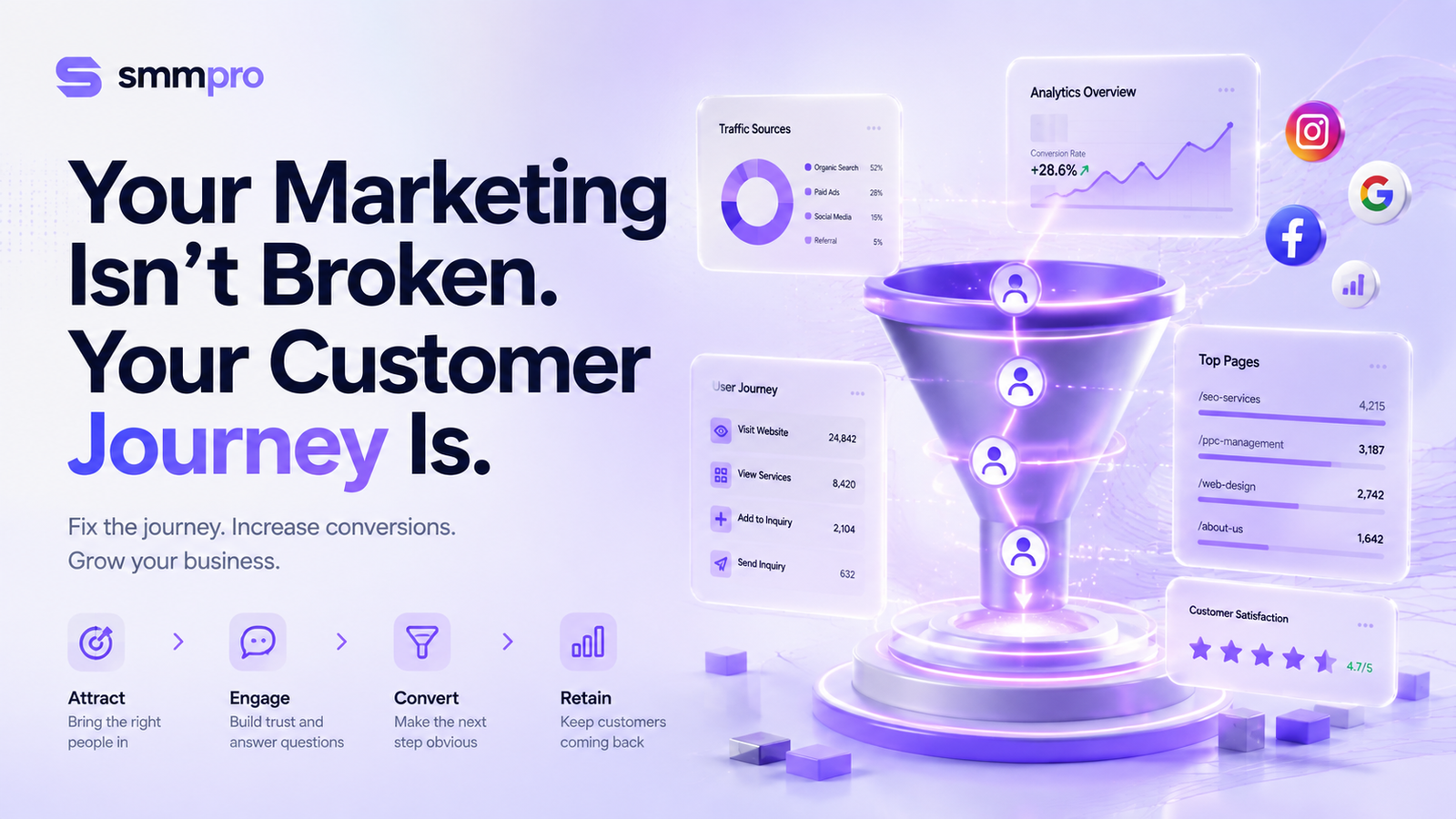
Customers don’t experience any of that. Nobody thinks “I’m now entering the SEO stage of this funnel.” They move from one interaction to the next: an Instagram post, a search, a blog article, a service page, a two-week pause, a look at pricing, a scan of the reviews, and eventually an enquiry. Or not.
They see one business. When every channel tells a slightly different story, the experience gets confusing, and confused visitors don’t convert.
Problem #1: The Wrong Expectation
The fastest way to lose a potential customer is to give them something different from what they expected.
Someone searches “SEO agency for small businesses,” clicks your result, and lands on a page about enterprise SEO, technical audits, and large-scale ecommerce migrations. You might be excellent at SEO. But you’ve just told them, indirectly, that this probably isn’t for them. They leave. In your analytics that looks like a bounce. From their side it was a perfectly logical decision.
Paid ads do the same thing. The ad promises a free consultation for ecommerce SEO, the click lands on a ten-service homepage that says “Welcome to our digital marketing agency,” and the obvious next step vanishes. The problem usually isn’t the ad. It’s the handoff. Sometimes the biggest improvement to a PPC campaign isn’t a new keyword, it’s a better landing page.
A message-match checklist worth running on every ad and high-intent page:
- Does the H1 echo the ad headline or the search intent?
- Does the hero image match the offer?
- Is the CTA verb consistent? (“Get a free audit” is not the same promise as “Book a call.”)
- Is the offer above the fold, with minimal navigation competing for attention?
- Do trust signals appear before you ask the visitor for anything?
Your Homepage Isn’t Always Your Best Landing Page
Businesses pour months into a beautiful homepage, then send almost everyone there. It’s the main page. It represents the company. It has everything on it. That’s exactly the problem.
This is more common than most marketers assume, and the cost shows up in the numbers. HubSpot’s research found that businesses running 10 to 15 landing pages generate roughly 55% more leads than those running fewer than ten. The gap isn’t about design quality. It’s about specificity.
A shop owner in Lahore searching for “ecommerce website for clothing brand” doesn’t want your whole business. They want to know four things: do you build this, have you done it before, roughly what does it cost, and how do I reach you? A focused page answers that in seconds. A homepage makes them hunt.
Rule of thumb: the more specific the query, the more specific the destination should be. Send paid traffic and high-intent search queries to topic-matched pages, and keep the homepage for brand discovery and broad navigation. This is where conversion-focused website design earns its keep, because the visitor never has to stop and re-orient themselves.
The Click Is the Beginning, Not the Outcome
SEO teams focus on the click because clicks are measurable. But a visitor needs to answer three questions within seconds of arriving:
- What do you do?
- Is it relevant to me?
- What should I do next?
If those aren’t obvious, you have a conversion problem no amount of traffic will solve. Fixing it usually means removing confusion rather than adding content.
An above-the-fold checklist for any key page:
- A benefit-driven headline that matches the ad or the query
- One sentence explaining who it’s for and what they get
- A visible primary CTA with an action verb (“Start my free audit”)
- One strong trust signal: a logo bar, a testimonial, a rating, or a specific result
- Minimal navigation on dedicated landing pages
More Information Can Make a Page Worse
There’s always a temptation to explain everything. More services, more features, more FAQs, more testimonials, more buttons. None of it is automatically helpful.
The data backs this up. Landing pages with a single link convert at around 13.5% on average. Add two to four links and that falls to 11.9%. Five or more and it drops to 10.5%. Every extra option is a small invitation to leave.
Complexity of language works the same way. Unbounce’s analysis of 41,000 landing pages found that pages written at a fifth-to-seventh-grade reading level convert at 11.1%, against 5.3% for pages written at a professional level. Clear beats clever, consistently.
Imagine asking a salesperson which laptop is best for video editing and having them walk you through every laptop in the shop. Technically informative. Completely unhelpful. The fix is order, not volume: establish relevance, then value, then reduce uncertainty, then offer an easy next step. That sequence is the customer journey.
Trust Comes Before Conversion
Asking for too much too soon is the other common mistake. Someone discovers your company for the first time and immediately sees “Book a strategy call.” They don’t know you, haven’t seen your work, and haven’t decided whether you’re credible.
For some businesses a direct CTA works fine. For others, the visitor needs a smaller first step: a guide, examples of past work, a plain explanation of how you work. Match the next step to their actual level of interest. Don’t force a ready buyer through five extra stages, and don’t treat a first-time visitor as though they’re ready to sign.
Content Should Move the Reader Forward, Not Just Rank
A business publishes an article because the keyword has volume. It ranks, people read it, and nothing happens, because the piece answered a question without giving anyone a reason to keep going.
Good content doesn’t need to sell. It does need to connect logically to whatever the reader might want next. Someone reading “How much does a website cost?” might reasonably want “What to look for when choosing a web development company.” That beats a generic Contact Us button at the bottom of every post.
A simple internal-linking pattern:
- Awareness-stage posts link to one consideration-stage guide or comparison
- Consideration-stage pages link to one decision-stage page: pricing, demo, or enquiry
- Every thank-you page offers a clear next step, not a dead end
Don’t Ignore the People Who Aren’t Ready Yet
Not everyone converts today. Someone might still be understanding their problem, comparing three competitors, or waiting on next month’s budget. If your only options are “Buy now” or “Book a call,” you have no way to stay in the conversation with anyone who isn’t ready. That’s what email, useful content, and remarketing are for. The goal isn’t to pressure a decision, it’s to be remembered when the decision arrives. This matters most for considered, higher-cost purchases; for low-commitment offers, a direct CTA often converts perfectly well.
The Audit: Five Questions Before You Buy More Traffic
Pick one important page and work through this honestly:
- Where did the visitor come from, and what were they probably looking for?
- Does the page address that need immediately, or does it introduce the company first?
- Does the headline confirm they’ve landed in the right place?
- Is there one clear next step, plus a softer option for people who aren’t ready?
- Is there anything on the page that supports neither of those?
Then check the numbers. If a page gets plenty of traffic but few people move forward, more traffic won’t fix it. It will just make the same broken journey more expensive to run. At Brandmek, this is the audit we run before recommending a single change to a client’s ad spend.
What This Actually Comes Down To
Good marketing looks simple from the outside. Someone searches, finds the right page, gets their question answered, trusts the business, and knows what to do next. The hard part is making every piece of that sequence work together.
So instead of asking which channel to invest in next, ask what happens to someone after they find you. That question surfaces problems another campaign, another budget, or another month of content won’t solve.
FAQ
FAQs about Your Marketing Isn’t Broken. Your Customer Journey Is
A website can receive substantial traffic and still generate few leads or sales when the visitor’s intent does not match the landing page, the value proposition is unclear, trust is weak, or the next step is difficult to find. Before increasing traffic, identify where visitors are dropping out of the customer journey.
Visitors commonly leave because they cannot quickly understand what the business offers, whether it is relevant to them, why they should trust it, or what they should do next. Poor message match, confusing navigation, weak CTAs, slow pages, and excessive choices can all contribute to abandonment.
A customer journey is the sequence of interactions a person has with a business, from discovering it through search, social media, advertising, or referrals to researching the offer, building trust, making a decision, and potentially becoming a customer or returning customer.
Start by identifying the visitor’s intent, matching the page to that intent, improving the headline and value proposition, strengthening trust signals, using one clear primary CTA, reducing unnecessary distractions, and testing changes based on actual user behavior and conversion data.
High-intent Google Ads traffic should generally go to a dedicated, topic-matched landing page rather than a broad homepage. A focused landing page can continue the exact promise made in the ad and make the desired action easier to understand.
Message match means keeping the wording, offer, intent, and expectations consistent between the user’s search query or advertisement and the page they reach. For example, an ad promising an ecommerce SEO audit should lead to a page clearly focused on that same audit rather than a generic digital marketing homepage.
Landing pages can increase conversions by focusing on one audience, one problem, one offer, and one primary action. They reduce distractions and help visitors quickly understand the offer, see evidence of credibility, and take the next step.
A landing page should normally have one primary conversion goal. The CTA can appear more than once on a long page, but competing primary actions can create unnecessary choice and distract visitors from the intended next step.